
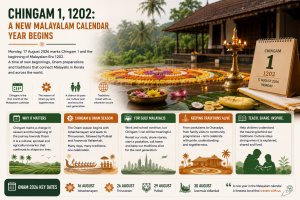
There is something about the middle of August that feels different for many Malayalis. The monsoon is still part of everyday life, Onam preparations are beginning, and the Malayalam calendar turns to Chingam — its first month and the start of another year.
Monday, 17 August 2026 marks Chingam 1 and the beginning of Malayalam Era 1202.
For families in Kerala and Malayalis living across the Gulf, it is a small but meaningful date — a connection to a calendar that continues to shape festivals, traditions and family life even though most everyday schedules now follow the Gregorian calendar.
Why does Chingam feel special?
Chingam is the first month of the traditional Malayalam calendar.
For generations, its arrival has been associated with the period following the heavy monsoon and with the season leading into Onam, Kerala’s biggest cultural celebration.
Not every family observes Chingam 1 in the same way.
For some, it has religious significance. For others, it is connected with agriculture or family tradition. And for many younger Malayalis, particularly those growing up abroad, it may simply be the time when conversations about pookalam, Onasadya and Onam celebrations begin to become more frequent.
Chingam and the Onam season
This year, Chingam arrives right as the Onam season gathers momentum.
The 2026 festival calendar places Athachamayam on 16 August, followed by Thiruvonam on 26 August, Pulikali on 29 August and the Aranmula Vallamkali on 30 August.
That is a useful reminder that Onam is not simply one day.
The celebration develops through pookalams, family gatherings, food, cultural performances and community events across several days.
Chingam is the month that holds much of that experience together.
What can it mean for Gulf Malayalis?
Life in Dubai, Abu Dhabi, Doha, Muscat or elsewhere in the Gulf does not change because the Malayalam calendar has turned to a new year.
It may still be a normal workday. Children may have school. Community Onam celebrations may be moved to a convenient weekend.
But Chingam 1 can still provide a simple opportunity to keep a connection with Kerala alive.
Parents could show children how the Malayalam calendar works, explain why the year is 1202 rather than 2026, call grandparents or relatives back home, or begin a small pookalam as Onam approaches.
None of this needs to become a formal ceremony.
For children growing up outside Kerala, understanding why a tradition exists may ultimately be more valuable than simply repeating it.
A calendar that travels with Malayalis
The Malayalam calendar was created in a very different time and place, yet its festivals and dates now travel with Malayali communities around the world.
A family in Kerala may experience Chingam through the weather, local celebrations and neighbourhood preparations.
A family in the Gulf may experience the same season through weekend Onam programmes, video calls home and a pookalam made inside an apartment.
Both are part of the same continuing story.
MalluMetro Take
Chingam 1 does not need a grand celebration to be meaningful.
Sometimes it is simply a date that reminds Malayalis — especially those living far from Kerala — that culture can travel with a family.
A new Malayalam calendar year begins with Chingam. What keeps it meaningful is passing the stories behind those dates to the next generation.