
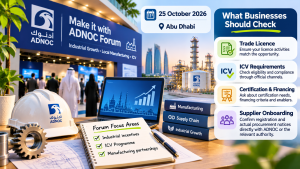
ADNOC has announced more than AED60 billion in local manufacturing opportunities through 2030, giving UAE manufacturers and industrial suppliers clearer visibility of products the company wants to source locally.
The announcement came at the second Make it with ADNOC Forum, held at Emirates Palace in Abu Dhabi on 25 October 2026.
More than 1,000 local companies and manufacturers participated in the forum, where ADNOC also announced significant changes to its supplier registration, procurement and In-Country Value frameworks.
For businesses, the important point is not simply the AED60 billion headline.
It is understanding what ADNOC may need, whether your company can genuinely supply it, and what formal qualification process stands between interest and an actual commercial opportunity.
What products is ADNOC looking to manufacture locally?
ADNOC says the identified opportunities extend across more than 200 essential products, together with a broad range of critical spare parts currently needed across its projects and operations.
Priority areas include:
- rotating equipment and power systems;
- electrical equipment;
- control and automation systems;
- drilling and completion equipment;
- chemicals and catalysts;
- piping;
- fabrication;
- heavy equipment;
- critical spare parts; and
- advanced manufacturing.
Many of these products are currently imported.
ADNOC’s localisation strategy is therefore aimed partly at reducing overseas supply dependence, shortening lead times and building stronger industrial capacity inside the UAE.
For an existing UAE manufacturer, the opportunity may be to expand production.
For an overseas manufacturer, it may mean considering local production or a UAE industrial partnership.
For a trader or distributor, however, the announcement should not automatically be interpreted as an opportunity to simply import and resell the listed products. The strategic emphasis is clearly on localisation and UAE manufacturing.
Is AED60 billion an open tender?
No.
This is one of the most important distinctions for businesses to understand.
The AED60 billion represents ADNOC’s projected local manufacturing opportunities through 2030.
It is not one tender.
It is not AED60 billion available as grants.
And it does not mean every company attending the forum has been awarded business.
Individual procurement opportunities will still have their own:
technical specifications, qualification requirements, commercial evaluation, tender process and contractual conditions.
Businesses should therefore treat the figure as an indication of future demand, not guaranteed revenue.
Supplier registration is being simplified
One of the most useful announcements for existing and prospective suppliers concerns ADNOC’s onboarding process.
ADNOC says its redesigned supplier registration and prequalification model aims to reduce the time required to become ready to compete for opportunities by up to 80%.
The new approach is also expected to:
- cut required documentation approximately in half;
- remove prequalification requirements for around 60% of service categories;
- combine registration, qualification and compliance into a single-window process;
- reuse existing supplier information rather than repeatedly requesting the same data; and
- use AI to assist document verification.
ADNOC also says wider procurement changes aim to reduce purchasing cycles by up to 40%.
For suppliers that have previously found the onboarding process lengthy, these changes could become significant.
How do businesses register with ADNOC?
The formal route is the ADNOC Supplier Hub.
ADNOC describes it as the central gateway for doing business across the ADNOC Group. Registration and prequalification themselves do not carry an ADNOC service fee.
The current registration journey includes:
1. Create or link an SAP Ariba account
2. Submit the supplier registration questionnaire
3. Complete Integrity Due Diligence
4. Undergo ADNOC review
5. Receive registration approval and an ADNOC Unified ID
6. Proceed to applicable product or service prequalification
Prequalification can involve assessment of supplier experience, technical capability, HSE, quality documentation and, where necessary, a facility audit or desktop assessment.
Companies should check the current Supplier Hub requirements against their exact licence and business activity before making investments based on a potential ADNOC opportunity.
Does an ICV certificate guarantee work?
No.
But it can affect competitiveness.
ADNOC’s Supplier Hub currently states that an ICV certificate is not mandatory simply to participate in an ADNOC tender, but suppliers with stronger ICV scores can obtain a competitive advantage in evaluation.
ADNOC’s ICV model evaluates factors including:
- goods manufactured in the UAE;
- domestic third-party spending;
- investment and manufacturing depth; and
- Emiratisation and local workforce contribution.
The updated ICV framework will also bring commercial and ICV offers into a single evaluation approach, replacing the earlier bid-matching model.
For businesses, that means the strongest position is not simply:
“We have an ICV certificate.”
It is:
“We are commercially competitive and create meaningful value inside the UAE.”
Local+ could be particularly important for manufacturers
Another programme worth understanding is Local+.
It requires EPC contractors participating in relevant new ADNOC tenders to source specified UAE-made products from approved local manufacturers when those manufacturers meet technical, qualification and commercial requirements.
The programme started earlier in 2026 with around 70 approved manufacturers.
By the October forum, ADNOC said the Local+ network had expanded to more than 100 UAE manufacturers.
This can create a much more direct advantage for manufacturers than simply appearing in a generic supplier database.
However, companies should not assume they can self-declare as Local+ suppliers.
They must meet ADNOC’s technical and qualification requirements and be included through the relevant approval process.
Financing exists — but it is not automatic
The forum also linked manufacturing demand with government-supported industrial financing.
ADNOC, the Ministry of Industry and Advanced Technology and the Abu Dhabi Investment Office are working together to connect identified manufacturing opportunities with industrial incentives and financing mechanisms.
One relevant programme is the AED1 billion National Industrial Resilience Fund, managed through Emirates Development Bank over five years.
The fund is designed particularly to support existing industrial facilities that need to expand production capacity in response to identified strategic demand.
That does not mean every company considering ADNOC supply automatically qualifies for financing.
Businesses still need to demonstrate viability, eligibility and compliance with the financing programme’s requirements.
Existing factories may have an advantage over starting from zero
For entrepreneurs considering this opportunity, there is an important commercial distinction.
An established manufacturer that already has:
an industrial licence, factory, quality systems, technical staff, production history and relevant certifications
may be much closer to ADNOC qualification than a newly formed trading company hoping to enter industrial manufacturing.
Starting a factory solely because ADNOC has announced AED60 billion of future demand would therefore be risky without first establishing:
- the specific product required;
- technical specification;
- projected demand;
- existing approved suppliers;
- required certifications;
- likely capital investment;
- achievable production cost; and
- realistic qualification timeline.
The right sequence is generally:
identify demand → verify technical requirements → evaluate capability → understand qualification → build the investment case.
Not:
open factory → hope for ADNOC contract.
What should a UAE SME or manufacturer check first?
A company seriously interested in the opportunity should begin with five questions.
Does my trade or industrial licence cover what I want to supply?
Do not assume a general trading activity is sufficient for manufacturing or specialised oil-and-gas supply.
Does ADNOC have an approved product or service group matching my capability?
The Supplier Hub publishes product and service classifications used for prequalification.
Can my company meet the technical, quality and HSE requirements?
Lowest price alone will not qualify an unapproved manufacturer.
What is my current ICV position?
Calculate whether greater UAE manufacturing, domestic procurement or workforce investment could improve competitiveness.
Is the demand large and stable enough to justify investment?
A procurement forecast can indicate opportunity, but a business still needs its own commercial feasibility study.
This is also relevant to technology companies
The opportunity is not confined to conventional fabrication and mechanical manufacturing.
ADNOC specifically identifies electrical systems, control and automation, advanced manufacturing and power-related equipment among the localisation opportunities.
That creates potential relevance for companies working in:
industrial automation, instrumentation, control panels, electrical systems, digital manufacturing, specialised electronics and related technologies.
Again, the same qualification principle applies.
The fact that a company works in technology does not make it an ADNOC-qualified supplier automatically.
What has ADNOC’s ICV programme already achieved?
ADNOC says its ICV programme has redirected more than AED307 billion into the UAE economy since 2018.
By the end of 2025, it had also supported:
- localisation of more than 130 products;
- development of approximately 95 UAE factories; and
- tens of thousands of private-sector employment opportunities for Emiratis.
Those figures help explain why the October announcement should be viewed as part of a longer industrial-localisation strategy rather than a one-off procurement campaign.
What businesses should do now
For UAE manufacturers and serious industrial suppliers, the useful next steps are practical:
1. Review ADNOC’s Supplier Hub and relevant product groups.
2. Check that the company’s trade or industrial licence matches the intended activity.
3. Determine whether registration or prequalification is required for the relevant category.
4. Review the company’s current ICV position.
5. Identify technical certification, QA/QC and HSE gaps before bidding.
6. Investigate Local+ eligibility if the company manufactures applicable products in the UAE.
7. Assess financing only after there is a credible manufacturing and demand case.
And most importantly:
use ADNOC’s official procurement and supplier channels for actual tenders.
A forum announcement, LinkedIn post or consultant’s message is not a substitute for an official sourcing event.
MalluMetro Take
The most important number from Make it with ADNOC is not necessarily AED60 billion.
For a business owner, the more useful question is:
Is there one specific product within that AED60 billion opportunity that my company can manufacture competitively, qualify technically and supply reliably from the UAE?
That is where the announcement becomes a real business opportunity.
ADNOC is making supplier registration faster, expanding Local+, changing ICV evaluation and giving manufacturers earlier visibility of future demand.
But none of that removes the fundamentals:
licensing, technical capability, quality, pricing, ICV, prequalification and commercial viability still matter.
For Gulf Malayali entrepreneurs and UAE SMEs, this is therefore worth investigating — but as a structured industrial opportunity, not as a promise of an ADNOC contract.
Verified sources: ADNOC; ADNOC Supplier Hub; Ministry of Industry and Advanced Technology; Abu Dhabi Media Office; Emirates News Agency. Forum outcomes and current supplier information rechecked 12 November 2026.
Source: Emirates News Agency, 24 October 2026.