
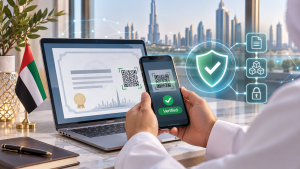
Received a UAE government certificate or digital document and want to know whether it is genuine? UAE Verify provides an official way to check supported documents against their issuing source.
The platform, operated by the Telecommunications and Digital Government Regulatory Authority (TDRA), allows individuals, businesses and government organisations to verify eligible digital documents issued by participating UAE entities.
According to TDRA’s latest update, UAE Verify now supports 88 types of documents from 32 federal and local government entities. More than 42.9 million trusted digital documents have been issued through the system since its launch in 2022, while more than 1.25 million documents have been verified.
For residents, the useful part is straightforward:
a supported document can be checked digitally instead of relying only on a PDF, screenshot or printed copy.
What exactly does UAE Verify check?
UAE Verify is designed to confirm three things:
Authenticity — whether the document came from the official issuing source.
Integrity — whether its contents have been altered after it was issued.
Validity — whether the issuing authority still considers the document valid based on its current status.
The platform does this by comparing a unique digital fingerprint of the document—known as a hash—with information registered through the UAE Verify system.
If the document has been altered, the digital fingerprint will no longer match.
How can you verify a document?
There are currently two main routes.
1. Upload the document to UAE Verify
A recipient can go to the official UAE Verify platform and upload or drag the supported digital document into the verification area.
The system checks the document against the trusted record held through UAE Verify and reports its authenticity and validity.
2. Scan its QR code through UAE PASS
Supported Trusted Digital Documents can also contain a QR code.
The recipient can scan that QR code using UAE PASS to verify the document against its official source.
This is useful when a certificate or record is being shared electronically between an individual and another person, employer or organisation.
How do you know whether a document supports UAE Verify?
TDRA says a verifiable Trusted Digital Document should contain instructions in the document footer together with the UAE Verify logo.
That is an important distinction.
Not every PDF issued by a UAE government entity is automatically a UAE Verify document.
If you cannot verify a particular certificate through the platform, that does not automatically mean it is fake.
It may simply:
- come from an entity not yet participating in UAE Verify;
- belong to a document category that has not yet been integrated; or
- require verification through the issuing authority’s own system.
Where do Trusted Digital Documents come from?
Individuals can obtain supported digital documents through the relevant UAE Verify partner government entity.
They may also be able to request or add supported official documents through the UAE PASS Digital Vault after the document has been issued by its official source.
UAE PASS allows users to store and share eligible official digital documents with government departments and other supported service providers.
Does UAE Verify store your certificate on blockchain?
This is an important privacy point.
TDRA says the contents of the document and the holder’s personal information are not stored on the blockchain.
Instead, the system stores the document’s hash—a unique digital code representing that specific document.
That hash allows UAE Verify to establish whether the document being checked matches the original trusted record without exposing the underlying personal information on the blockchain.
Why could this matter for employment or business?
Digital document verification can be useful when organisations need to establish whether a certificate or official record is genuine.
Potential situations include:
employment documentation;
business transactions;
government applications;
licences and certificates;
education-related records; and
documents shared between organisations.
Instead of asking someone to provide another printed or certified copy, a receiving organisation may be able to verify an eligible digital document directly against its trusted source.
But there is an important limitation.
UAE Verify does not automatically mean every organisation must accept the document
Successful verification shows that the supported document is authentic, intact and valid according to the issuing source.
It does not necessarily determine whether that document satisfies the requirements of another authority or organisation.
For example, an employer, immigration authority, university or overseas government may still require:
- attestation;
- equivalency or recognition;
- translation;
- primary-source verification;
- additional supporting documents; or
- another prescribed verification process.
So there is an important difference between:
“Is this document genuine?”
and
“Will this organisation accept this document for my application?”
UAE Verify primarily helps answer the first question.
What if someone sends you only a screenshot?
A screenshot should not be treated as equivalent to the original verifiable digital document.
If verification is important, ask for the actual Trusted Digital Document or use the QR-code/official verification method provided with it.
A picture of a certificate can look genuine while providing no reliable way to confirm whether the underlying document has been altered.
Practical safety precautions
Residents should access UAE Verify and UAE PASS only through official government channels or the official apps.
Avoid uploading passports, Emirates IDs, certificates or other sensitive records to websites sent through unfamiliar messages or advertisements.
When receiving a document:
- check the issuing authority;
- look for UAE Verify instructions or the QR code;
- verify through the official platform;
- confirm that the document details match the person or organisation presenting it; and
- separately check whether the receiving organisation requires any additional attestation or recognition.
Why the platform is expanding
UAE Verify was launched in January 2022 as part of the UAE’s wider move toward paperless and digitally verifiable government services.
TDRA says the platform uses blockchain-based technology to allow government entities, private organisations and individuals to establish trust in digital records while allowing documents to be shared electronically.
The expansion to 88 supported document types and 32 issuing entities shows that digital verification is increasingly becoming part of the UAE’s government-service infrastructure.
MalluMetro Take
The most useful feature of UAE Verify is not the blockchain terminology.
It is something much simpler:
a person receiving a supported government document can check whether it genuinely came from the issuing authority and whether it has been changed.
That can make digital certificates much more useful than ordinary PDFs or screenshots.
But residents should remember the second half of the equation:
verification proves authenticity; it does not automatically prove that a document meets every requirement for employment, immigration, university admission or another official process.
Check the document through UAE Verify first.
Then check what the organisation receiving it actually requires.
Verified sources: Telecommunications and Digital Government Regulatory Authority (TDRA), UAE Verify and UAE PASS; latest platform statistics published 6 November 2026.
Source: Emirates News Agency, 6 November 2026.