
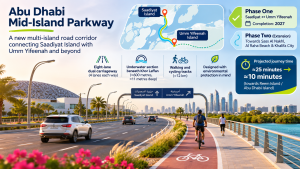
Abu Dhabi is building a new road corridor across its central islands, with the AED2.85 billion first phase of the Mid-Island Parkway scheduled for completion in 2027.
The project will create a direct road connection from Saadiyat Island to the Umm Yifeenah Island Central Interchange, adding another major east-west route across the capital’s island network.
For drivers, the important point is that this is not simply a new local road on Saadiyat.
It is the first section of a much larger transport corridor intended eventually to connect Saadiyat with Al Raha Beach, Khalifa City and, across the wider network, Zayed City.
What does Phase One connect?
Phase One starts from the existing northern Saadiyat interchange on the E12 and continues towards the southern end of Saadiyat before crossing towards Umm Yifeenah Island.
The road is being built as an eight-lane dual carriageway, with four lanes in each direction.
DMT says the completed connection is expected to reduce certain journeys towards Reem Island and Abu Dhabi Island from around 25 minutes to about 10 minutes.
Those are projected post-opening journey times.
Drivers should not treat them as current travel times or as a guarantee for every origin, destination or traffic condition.
Part of the road will run underwater
One of the most technically interesting parts of Phase One is the crossing beneath Khor Laffan.
DMT says approximately 1.5 km of the project runs underground, including a 600-metre underwater section reaching a depth of around 11 metres.
Another 2 km has been created on reclaimed land, protected by around 150,000 square metres of rock protection to reduce erosion.
Precast concrete roof panels were manufactured off site for the underground section, with the aim of reducing construction time and limiting the amount of work required inside the excavation area.
So although residents may eventually experience it simply as another road journey, part of the infrastructure underneath is considerably more complex.
Walking and cycling are part of the project too
The scheme is not limited to vehicles.
Phase One includes around 4 km of new walking and cycling tracks, creating a continuous route of approximately 12 km across Saadiyat Island and towards Umm Yifeenah Island.
That is significant because major highway projects in Abu Dhabi are increasingly being designed alongside active-mobility infrastructure rather than treating cycling and walking as separate additions.
The project also includes:
- approximately 23,000 metres of smart energy-saving lighting;
- around 14,000 metres of irrigation infrastructure;
- drought-resistant native landscaping; and
- greater use of locally sourced and recycled materials.
What is Phase Two?
Phase Two extends the corridor much farther south and east.
DMT says the next section will run approximately 14.5 km from Umm Yifeenah Island through Bilrimaid and Samaliyah Islands towards Sas Al Nakhl, Al Raha Beach and Khalifa City.
Like Phase One, it is planned with four lanes in each direction.
The project will include:
marine bridges, elevated flyovers and another underwater road tunnel.
DMT says the route has been designed to reduce disturbance to surrounding mangroves, salt marshes and coastal sabkha habitats, while keeping natural water channels open.
How much could journey times change?
For the Mid-Island corridor itself, DMT says Phase Two could reduce journeys along the route to around seven minutes once operational.
Looking at the wider project, the department says the fully completed corridor is intended to allow travel between Saadiyat Island and Zayed City in under 15 minutes.
Again, these are planning projections for the completed network.
They should not be read as guaranteed door-to-door travel times.
Why does the route matter?
Abu Dhabi’s island geography means that major developments depend heavily on a limited number of bridge and causeway connections.
Saadiyat already connects important destinations including:
Saadiyat Lagoons, Saadiyat Marina District and New York University Abu Dhabi.
The new corridor gives the island another strategic route towards the mainland and other central islands, potentially reducing dependence on existing connections.
It also supports wider development around Al Raha, Khalifa City and the central island corridor.
Is the whole project opening in 2027?
No.
The 2027 completion target applies to Phase One, the AED2.85 billion section connecting Saadiyat with Umm Yifeenah.
Phase Two is a separate and much longer extension.
DMT has revealed the alignment and major design features of Phase Two, but the October announcement does not provide a final public opening date for the complete Mid-Island Parkway corridor.
That distinction is important when reading headlines about the project.
What should drivers watch next?
The most useful future updates will be:
- the confirmed opening date for Phase One;
- any temporary traffic changes during final works;
- opening arrangements at the Saadiyat and Umm Yifeenah connections;
- construction milestones for Phase Two;
- how the route integrates with E12, E10 and surrounding road networks; and
- the opening of the associated walking and cycling routes.
Until those announcements are made, motorists should continue using the existing road network.
MalluMetro Take
The Mid-Island Parkway matters because Abu Dhabi is not simply adding another road.
It is creating a new transport spine across a chain of islands, using reclaimed land, underground and underwater construction, marine crossings and conventional highways in one corridor.
For residents, the benefit will ultimately be measured much more simply:
Does it make journeys between Saadiyat, Reem, Abu Dhabi Island, Al Raha and Khalifa City noticeably easier?
Phase One is expected in 2027.
The bigger story will unfold when Phase Two extends that route farther across the emirate and the Mid-Island Parkway begins operating as one connected corridor.
Verified source: Abu Dhabi Department of Municipalities and Transport. Latest official project information rechecked 12 November 2026.
Official source: Abu Dhabi Media Office, 1 October 2026.