
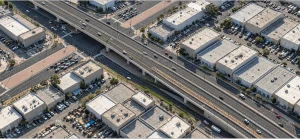
Abu Dhabi is planning a major redesign of some of Musaffah’s busiest roads, with approximately 13 kilometers of improvements along E30 and 8th Street intended to reduce congestion and improve connections with Mohamed Bin Zayed City and Zayed City.
The Department of Municipalities and Transport (DMT) says the programme will include a new free-flowing highway along 8th Street, upgrades to major interchanges and junctions, and new bridge connections between Musaffah and Mohamed Bin Zayed City.
For people who work, live or run businesses in Musaffah, the important point is that this is not simply another road-widening project.
The plan attempts to separate through traffic from vehicles entering shops, workshops and local businesses — one of the practical reasons traffic can become difficult in the area.
What is planned for 8th Street?
DMT plans to create a free-flowing highway with three lanes in each direction along 8th Street.
Alongside those express lanes, another three lanes on each side are planned to provide access to shops, amenities and businesses without forcing local traffic directly into the faster-moving highway lanes.
The overall corridor is expected to accommodate approximately 4,000 vehicles per hour.
That separation between through traffic and local access could be particularly important in Musaffah, where passenger vehicles, commercial traffic, buses and delivery vehicles often use the same corridors.
E30 will also be upgraded
The programme extends beyond 8th Street.
DMT says four interchanges along E30 will be upgraded, alongside improvements to connections with 8th Street and E20.
Another nine major junctions are planned for modification.
The objective is to improve movement both through Musaffah and between the industrial area and surrounding residential communities.
Two new road bridges are planned
The project also includes plans for two new bridges connecting Musaffah and Mohamed Bin Zayed City.
A separate pedestrian bridge is also planned.
These connections could become particularly useful for people who commute regularly between Mohamed Bin Zayed City and Musaffah’s industrial, commercial and employment areas.
However, DMT has not yet published detailed public information covering the final alignment, opening dates or traffic arrangements for every bridge component.
Does this change the commute today?
Not yet.
These are planned infrastructure improvements.
Drivers should not assume that faster journeys or new access routes are already available.
The 11 October announcement did not provide a comprehensive programme showing:
- construction start dates for every section;
- temporary lane closures;
- diversion routes;
- individual interchange completion dates; or
- a final opening date for the entire programme.
Until those details are issued, commuters should continue following current Abu Dhabi Mobility and DMT traffic information.
Why separating local and through traffic matters
Musaffah presents a different transport challenge from a conventional residential district.
The road network serves:
workers travelling to businesses and industrial sites;
residents making local journeys;
trucks and commercial vehicles moving goods;
customers accessing workshops, shops and services; and
traffic passing between surrounding communities.
DMT says the new design is intended to manage those different movements more effectively by keeping vehicles travelling through the area separate from traffic accessing local properties.
If implemented effectively, that may prove more important than simply adding lanes.
The road project is part of a much larger Musaffah plan
The transport upgrades are also tied to Abu Dhabi’s broader plans for the district.
DMT launched the Musaffah Innovation District in October as a long-term programme intended to transform the area into a more modern industrial, logistics, commercial and investment hub.
The first phase of that wider development programme runs to 2030 and includes enabling infrastructure such as the 8th Street and E30 corridor projects.
Plans also include development in northern Musaffah and along the northern waterfront, new mixed-use and residential areas, a new district centre and upgrades to the existing automotive cluster.
This means the road improvements should be understood as infrastructure supporting a much larger transformation of Musaffah rather than as an isolated traffic project.
Logistics and businesses are part of the reason
Musaffah remains one of Abu Dhabi’s most important areas for:
manufacturing, automotive services, warehouses, construction-related businesses, wholesale trade and logistics.
The Innovation District plans specifically identify activities such as warehousing, cold storage, last-mile distribution, light industry and green construction as areas for future growth.
Road capacity therefore affects more than the morning commute.
Congestion can also influence delivery times, commercial vehicle movements and the cost of moving goods through one of the emirate’s key industrial areas.
An even bigger connection is planned in the longer term
DMT’s Musaffah road announcement also refers to another major future transport proposal:
a two-tunnel undersea connection between the eastern side of Abu Dhabi Island and Musaffah, running beneath Khor Al Maqta and the Al Hudayriyat Island channel.
That is a separate project and should not be confused with the 13 km E30 and 8th Street upgrade.
But together, the projects show how Abu Dhabi is looking at Musaffah as part of a wider metropolitan road network rather than simply as an industrial district on the edge of the city.
What should commuters watch next?
For residents and workers, the most useful future announcements will be practical ones:
When will construction begin on individual sections?
Which junctions will be affected first?
Will temporary diversions change access to particular industrial areas or businesses?
When will the new Mohamed Bin Zayed City bridges open?
When will the free-flow section of 8th Street become operational?
Those details will matter much more to everyday commuters than the announcement of the master plan itself.
MalluMetro Take
Musaffah’s traffic problem is not simply that too many vehicles use the roads.
It is that very different types of journeys often compete for the same space.
A truck moving between industrial sites, a worker heading towards Mohamed Bin Zayed City and a customer trying to enter a roadside workshop may all use the same corridor.
The planned redesign of 8th Street attempts to address that by separating through movement from local access.
If that works as intended, the most noticeable improvement may not simply be a wider road.
It could be a road network that is easier to understand and more predictable to use.
For now, however, this remains a project to watch.
The next important update will be the construction programme — particularly the first diversions, junction works and opening dates that directly affect daily commuters.
Verified sources: Abu Dhabi Department of Municipalities and Transport and Abu Dhabi Media Office. Latest specific Musaffah road-project information rechecked 12 November 2026.
Source: Abu Dhabi Media Office, 11 October 2026.