
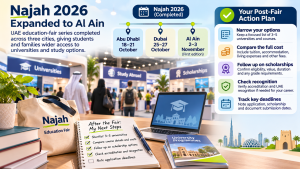
Najah’s 2026 UAE education-fair series has concluded after events in Abu Dhabi, Dubai and, for the first time, Al Ain — giving students and families access to universities, admissions teams, scholarship information and study-abroad guidance across three cities.
The series marked Najah’s 20th year and its widest UAE footprint so far.
Najah Abu Dhabi ran from 18–21 October, followed by Najah Dubai from 25–27 October, while the inaugural Al Ain edition was held at ADNEC Centre Al Ain on 2–3 November.
The fairs have now finished.
But for students who attended — or families who missed them — the more useful question is what to do next.
Dubai brought together more than 100 universities
Najah Dubai 2026 brought more than 100 universities from 20 countries to Dubai World Trade Centre.
The exhibition covered undergraduate and postgraduate study, admissions, scholarships, international education pathways and future career planning.
The Dubai World Trade Centre programme also included more than 30 expert-led seminars, covering areas such as study choices, careers and scholarship opportunities.
For families who collected prospectuses or spoke to several institutions, the important work starts after the exhibition:
turning those conversations into a manageable shortlist.
Al Ain hosted Najah for the first time
The 2026 series also brought Najah to Al Ain for the first time.
The two-day exhibition at ADNEC Centre Al Ain connected students and parents with UAE and international universities, admissions advisers and academic representatives covering undergraduate, postgraduate, foundation and professional-study options.
The organiser described the inaugural event as two days of busy halls and conversations between students, families and universities.
The expansion matters because students in Al Ain and surrounding communities previously had to travel farther to access an event of this scale.
If you attended Najah, do not leave the brochures in a bag
A university fair can create the illusion of progress because students leave with brochures, QR codes and contact details.
But collecting information is only the first step.
Within a few days of attending an education fair, create a shortlist of perhaps three to five serious options.
For each one, compare the same information:
Course content
What modules will you actually study?
Recognition and accreditation
Is the university and programme recognised for the purpose you intend to use the degree for?
Total cost
Do not compare tuition alone. Include registration fees, accommodation, transport, insurance and living expenses where relevant.
Scholarships
What percentage is covered, for how long and what grades must be maintained?
Internships and industry exposure
Does the programme include placements, projects or employer partnerships?
Graduate outcomes
Where do graduates typically work or continue their studies?
Application deadline
When do documents, deposits and scholarship applications have to be submitted?
Scholarship conversations need follow-up
A phrase such as “scholarships available” can mean very different things.
One university may provide a substantial merit scholarship.
Another may offer only a limited tuition reduction.
Some awards apply for the full programme, while others have to be renewed annually based on academic performance.
If a university representative discussed a scholarship at Najah, follow up in writing and ask for:
- the exact scholarship name;
- eligibility conditions;
- value or percentage;
- duration;
- minimum GPA required to retain it;
- application deadline; and
- whether places or funding are limited.
Keep the written response.
Do not make a major financial decision based only on what was discussed verbally at an exhibition stand.
Studying abroad requires a second comparison
Families considering the UK, Canada, Australia, Europe, the United States or another destination should compare more than university rankings.
Ask what happens after admission.
That includes:
student visa requirements;
accommodation;
health insurance;
working rights during study;
internships;
cost of living;
travel expenses; and
post-study options where applicable.
A university with a lower tuition fee may not necessarily produce the lower overall cost.
For UAE-based families, the financial comparison should ideally be made for the whole academic year, not only the headline tuition amount.
Recognition should be checked before paying a deposit
This deserves particular attention.
A university representative can explain its own accreditation, but students intending to use the qualification in the UAE should separately check any recognition, professional-registration or equivalency requirements relevant to their intended career.
That matters especially in regulated or professionally recognised areas such as:
engineering, healthcare, teaching, law and some technical professions.
The right question is not simply:
“Is this university accredited?”
It is:
“Will this specific qualification be accepted for what I intend to do with it?”
AI and future careers should influence the questions — not dictate the degree
Najah’s 2026 programme placed considerable emphasis on the changing labour market and helping students understand how technology is reshaping future careers.
That does not mean every student should choose computer science or artificial intelligence.
A better approach is to ask how technology is changing the profession the student already wants to enter.
Future accountants will use more automation and data tools.
Engineers will work with increasingly digital project environments.
Healthcare professionals will encounter AI-supported systems.
Designers and communications professionals will work alongside generative technologies.
The aim should therefore be to choose a qualification that builds both core professional knowledge and adaptable skills.
Missed Najah? You have not missed the university application process
Families who did not attend the exhibitions can still contact universities directly.
The fair is a convenient way to meet many institutions in one location, but it is not a requirement for applying.
Students can still:
- attend university open days;
- book admissions calls;
- request scholarship information;
- visit campuses;
- attend online information sessions; and
- speak directly with admissions departments.
In fact, visiting a campus after narrowing the list can sometimes be more useful than meeting a university for ten minutes at a large exhibition.
Prepare an education comparison sheet
A simple spreadsheet can make the decision much clearer.
Use one row per university and compare:
University | Course | Country | Duration | Recognition | Tuition | Scholarship | Living Cost | Internship | Application Deadline
Families can then compare like with like rather than relying on which university stand had the strongest presentation.
The purpose is not necessarily to identify one “best university.”
It is to identify the institution that makes the most sense for that particular student, course, budget and career direction.
MalluMetro Take
Najah 2026 gave UAE families something valuable:
access to a large number of universities and advisers in one place.
But an education fair should narrow a decision, not make it more confusing.
The useful next step is to turn hundreds of options into a small number of realistic ones.
For every university still on the list, ask:
Is the qualification recognised?
Can we realistically afford the entire programme?
What will the student actually learn?
What practical experience will they gain?
And where could that education lead afterwards?
A brochure can introduce a university.
The real decision begins after the exhibition ends.
Verified sources: Emirates News Agency (WAM), Dubai World Trade Centre, ADNEC Centre Al Ain and Najah Expo organiser information. The 2026 UAE series status was rechecked on 12 November 2026.
Source: Emirates News Agency, 17 October 2026.