
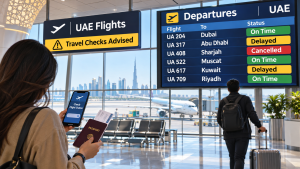
UAE airports remain operational, but passengers should still check their individual flight before leaving for the airport because some regional routes continue to face cancellations or schedule changes.
Dubai’s current official travel advisory says its airports remain open and flights continue to operate. Travellers are nevertheless being asked to keep their airline contact information updated so that schedule changes can reach them quickly.
The important distinction is simple:
there is no blanket cancellation of UAE flights, but individual routes can still be affected at short notice.
Which routes are currently affected?
One of the clearest current examples involves Etihad Airways.
Etihad says all passenger and cargo flights between Abu Dhabi and Riyadh and between Abu Dhabi and Dammam are cancelled through Thursday, 19 November 2026 because of ongoing regional disruption.
For Jeddah, selected Etihad services resumed from 6 November, while other scheduled Jeddah flights continue to operate.
Emirates separately says its codeshare flights with flydubai to and from Tel Aviv remain suspended until further notice.
These examples show why travellers should check the exact flight number rather than relying on general statements about whether UAE aviation is “open” or “closed”.
What about UAE–India flights?
The official travel pages checked by MalluMetro do not currently show a blanket suspension of UAE–India services.
That does not guarantee that every individual flight will operate exactly as scheduled.
Weather, aircraft rotations, airspace restrictions, operational changes or delays elsewhere in the network can still affect a specific journey.
Passengers travelling between the UAE and Kerala or other parts of India should therefore check their own booking directly with the airline shortly before departure.
Check the airline — not only a flight-tracking app
Third-party flight trackers can be useful, but they should not be the final authority when a journey is disrupted.
Before leaving home, check:
- the airline’s official website or app;
- the exact flight number and travel date;
- departure terminal;
- check-in status;
- any SMS or email from the airline; and
- each sector separately if the journey includes a connection.
If a flight is cancelled, the airline or booking agent should also be the first place to check rebooking and refund options.
Keep your contact information updated
Both Dubai’s official travel guidance and airline disruption notices emphasise the importance of having a correct mobile number and email address attached to the booking.
That may sound minor, but during fast-moving disruptions it can determine whether a passenger receives a cancellation or schedule-change notice before travelling to the airport.
If the ticket was purchased through a travel agency, check whether the airline has your own contact details rather than only the agency’s.
Do not buy a replacement ticket too quickly
If an airline cancels a flight, passengers may be offered:
rebooking, rerouting, travel credit or a refund, depending on the ticket, route and circumstances.
Before independently buying a second ticket, check what the original airline is offering.
Buying another flight first and trying to recover the cost later can create a much more complicated refund situation.
Connecting passengers need to check every sector
A traveller flying from Kerala through Abu Dhabi or Dubai to another country may have a first flight that operates normally while the onward sector is disrupted.
So do not check only the departure from India.
Verify:
India → UAE
UAE → final destination
and any onward connection after that.
Also review transit and entry requirements for the destination country.
For example, Emirates currently lists an additional attestation requirement for passengers travelling to or connecting through the United States, effective in November 2026.
Should passengers still go to the airport?
If your airline shows the flight as operating and has not advised otherwise, follow the normal airport instructions.
Do not skip a flight because of a forwarded WhatsApp message or an old cancellation list.
Likewise, do not travel to the airport simply because the airport itself is open if your specific flight has already been cancelled.
The two facts are different:
an airport can remain fully operational while individual flights are cancelled.
Where should travellers check?
For Dubai travel, the Department of Economy and Tourism maintains a current travel-advisory page.
For individual journeys, use the airline’s own flight-status and operational-update pages.
Etihad allows passengers to check flight status up to two days in advance and currently publishes affected-route information directly on its flight-status page.
Emirates similarly maintains a current travel-updates page for route and entry-related changes.
MalluMetro Take
The most useful message for travellers right now is not “UAE flights are disrupted.”
That is too broad.
The more accurate message is:
UAE airports are operating, but some routes remain affected and individual schedules can change.
For anyone travelling between the UAE, India or another international destination, the safest habit is simple:
check your exact flight directly with the airline before leaving home — and check it again if you have a connection.
Avoid screenshots of unofficial cancellation lists, keep your booking contact information updated, and do not make expensive alternative arrangements until you know what your airline is offering.
Verified sources: Dubai Department of Economy and Tourism; Etihad Airways; Emirates. Status rechecked 10 November 2026.
Official guidance: Dubai Department of Economy and Tourism travel advisory. Check the page and your airline again immediately before travel.