
Dubai Aerospace Enterprise has reported higher revenue and strong activity across aircraft leasing and engineering in the first half of 2026, offering another useful look at the scale of Dubai’s aviation ecosystem.
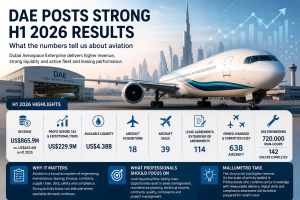
DAE reported revenue of US$865.9 million for the six months ended 30 June 2026, compared with US$843.6 million during the same period a year earlier.
Profit before tax and exceptional items reached US$229.9 million, while available liquidity stood at US$4.38 billion.
But the operational numbers are just as interesting.
During the period, DAE reported 18 aircraft acquisitions, 39 aircraft sales and 114 lease agreements, extensions or amendments.
Its owned, managed and committed fleet stood at 638 aircraft.
DAE Engineering also recorded around 720,000 man-hours and completed 142 aircraft checks.
Why these numbers matter
DAE’s results are not just about aircraft ownership or financial performance.
Modern aviation depends on a much wider ecosystem that includes engineering, maintenance, aircraft leasing, finance, contracts, procurement, technical records, quality, safety, data and regulatory compliance.
That is one reason Dubai’s aviation sector creates career opportunities far beyond pilots, cabin crew and airport operations.
Strong business activity does not automatically mean immediate recruitment, but it can indicate where technical and specialist capabilities continue to be needed.
What aviation professionals should notice
People hoping to move into the aviation sector may benefit from looking beyond airline-branded jobs.
Roles connected to aircraft asset management, maintenance planning, technical records, supply chain, contracts, quality assurance, compliance and project management are all part of the wider industry.
For professionals coming from engineering, infrastructure, ICT, project controls or regulated industries, some of these areas may also provide opportunities to transfer existing skills into aviation.
The challenge is showing how that previous experience applies to an aviation environment.
MalluMetro Take
The interesting part of DAE’s first-half results is not simply that revenue increased.
It is the scale of activity behind the numbers — aircraft being acquired and sold, leases being managed, engineering checks being completed and large volumes of specialist work taking place around them.
For job seekers, the message should not be “DAE results are strong, so jobs are coming.”
A more useful takeaway is this:
Aviation is much bigger than airlines and airports. Understanding the wider ecosystem can reveal career paths that many candidates never consider.