
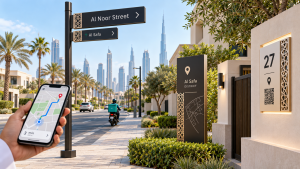
Dubai is changing the way neighbourhoods, streets and individual properties are identified, with a new addressing system that will gradually appear across the emirate from late 2026.
The initiative, developed by the Supreme Committee for Urban Planning in coordination with the Roads and Transport Authority and Dubai Municipality, introduces a unified visual identity for area signs, street-name signs and house-number plates. RTA
The project will eventually cover 186 areas across 19 sectors, with implementation beginning in the fourth quarter of 2026 and continuing through 2030. RTA
For residents, the change should become visible gradually rather than requiring everyone to update their address immediately.
Which areas will change first?
The first phase begins this year and covers:
- Za’abeel 1
- Za’abeel 2
- Nad Al Sheba
- Al Khawaneej 1
- Nazwa
More than 2,000 signs are due to be installed or replaced across these five areas during the initial phase. RTA
Dubai says implementation priorities are being determined using factors including population density, urban growth, tourist and residential importance, centrality and the number of streets that have not yet been formally addressed. RTA
What will actually look different?
The new identity introduces a coordinated design across:
area identification signs, internal street-name signs and house-number plates.
Instead of every location relying mainly on text and numbers, areas will also receive a visual identity built around five colours reflecting different geographic characteristics. RTA
For example:
Blue will be associated with areas close to the sea.
Gold will be used for areas characterised by a desert environment. RTA
The idea is to give neighbourhoods a recognisable visual character while keeping the overall system consistent across Dubai.
House-number plates are changing too
One of the most useful resident-facing changes will appear directly on buildings.
Dubai Municipality and RTA have approved new designs for house-number plates incorporating each property’s Makani number and a corresponding QR code. RTA
The colours on the house plates will correspond with the wider identity used for the surrounding area.
That means a property address could increasingly combine several layers:
area identity + street information + property number + Makani location + QR-based information.
What will the QR codes do?
The new system is intended to provide more than navigation.
QR codes will eventually give access to information about:
sectors and neighbourhoods, the meaning behind street and area names, nearby points of interest and other location-related information. RTA
That could make the addressing system useful to visitors as well as residents.
Someone encountering an unfamiliar street name, for example, may eventually be able to learn why it carries that name rather than using the sign only for navigation.
It will eventually appear beyond street signs
The visual identity is also planned to extend into:
bus stops, smart applications and area map boards. RTA
That is potentially more important than changing the colour of physical signs.
If the same addressing structure appears consistently across road signs, property plates, public transport and digital maps, it becomes easier for people to understand where they are and how different parts of the city connect.
Why addressing matters more than it sounds
An address is easy to overlook until it fails.
Clear location information affects:
deliveries, taxis, emergency services, visitors, property identification, businesses, navigation apps and everyday directions.
Dubai is also expanding rapidly, creating new neighbourhoods, roads and developments.
An addressing system therefore has to do more than identify places that already exist.
It must remain understandable as the city continues growing.
RTA says the objective is to make locations easier to identify and improve accessibility while also giving different parts of Dubai a clearer visual identity. RTA
Do residents need to change their saved addresses now?
No immediate action has been announced.
This is a phased infrastructure rollout running through 2030.
Residents should therefore not start rewriting delivery addresses, company records or saved locations simply because the new identity has been announced.
For the moment, continue using your existing address, Makani number and location-sharing methods normally.
If an individual area receives new signage or Dubai authorities introduce changes affecting official address records, residents should follow the specific instructions issued for that stage.
What about Google Maps and other navigation apps?
The announcement says the identity will later extend into smart applications, but it does not yet provide detailed instructions about how or when third-party navigation platforms will display the changes. RTA
So readers should not assume that Google Maps, Apple Maps or delivery applications will immediately display new colours, sector identities or address formats.
That will be something worth checking as implementation progresses.
This is more than a rebranding exercise
At first glance, new colours and redesigned signs can look like a visual-branding project.
But the more significant elements are the ones underneath:
consistent location identification, property-level Makani information, QR integration and eventual connection with public transport and digital services.
If those pieces work together, the project could make it easier for residents, visitors and service providers to locate places without relying on lengthy landmark-based directions.
MalluMetro Take
Dubai residents have long used a mixture of street names, building names, landmarks, Google Maps pins and Makani numbers to explain where something is.
The new system appears designed to make those layers more coherent.
The real test will therefore not be whether the new signs look better.
It will be whether someone trying to find a villa, shop, office or bus stop can reach it more quickly and with less confusion.
For now, residents do not need to change anything.
Watch the first five areas — Za’abeel 1, Za’abeel 2, Nad Al Sheba, Al Khawaneej 1 and Nazwa — because they will provide the first practical indication of how Dubai’s new addressing identity works on the ground. RTA
Verified sources: Dubai Roads and Transport Authority, Dubai Municipality and Government of Dubai Media Office. RTA