
Dubai’s pharmaceutical sector is about much more than pharmacists standing behind a counter.
Manufacturing, quality, regulation, supply chains, clinical practice, research, digital systems and increasingly artificial intelligence all form part of the wider industry.
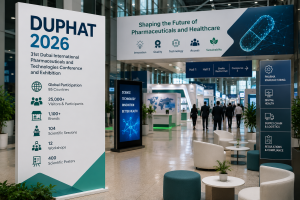
That broader picture was on display at DUPHAT 2026, the 31st Dubai International Pharmaceuticals and Technologies Conference and Exhibition, held from 25 to 27 August at Dubai World Trade Centre.
The event brought together pharmaceutical manufacturers, suppliers, distributors, pharmacists, researchers, regulators and technology specialists from around the world.
How large was DUPHAT 2026?
At the opening, organisers expected more than 25,000 visitors and participants from 85 countries.
The programme included:
- more than 1,100 brands;
- 104 scientific sessions;
- 12 workshops; and
- around 400 scientific posters.
That scale matters because it demonstrates how wide the pharmaceutical ecosystem has become.
DUPHAT was not limited to finished medicines. Its exhibition covered pharmaceutical manufacturing, ingredients, technology, supplements and wellness products, while its business platform connected manufacturers, distributors, pharmacies and buyers.
Where technology is entering pharmaceuticals
One of the more interesting themes for professionals is how quickly digital capability is entering traditionally regulated pharmaceutical work.
The 2026 programme included sessions on Pharma 4.0, AI-augmented workforces, computerised-system validation, digital maturity and the ethics of AI and data privacy in pharmacy.
That creates an important career message.
Digital transformation does not necessarily remove the need for pharmaceutical expertise.
Instead, organisations increasingly need people who can combine technical knowledge with quality, compliance, data and technology.
The jobs are wider than pharmacy
Growth in pharmaceuticals can create opportunities across several functions.
A manufacturing operation may require people in quality assurance, validation, engineering, procurement, production planning, maintenance and regulatory compliance.
A distributor needs warehousing, cold-chain operations, inventory systems, logistics and commercial teams.
Digital-health and pharmaceutical systems need people who understand data governance, cybersecurity, systems implementation and regulated processes.
Clinical organisations also need pharmacists, researchers and specialists focused on medication safety and patient outcomes.
So professionals interested in the sector should look beyond the word “pharma” in a job title.
What skills may become more useful?
For people considering a move into the sector, several capabilities are worth watching:
GMP and quality systems, regulatory affairs, supply-chain and cold-chain management, computerised-system validation, data analysis, project management and digital transformation.
But sector knowledge matters.
Someone with general project-management experience, for example, still needs to understand why pharmaceutical projects operate within strict validation, documentation and quality requirements.
A certificate alone does not create that experience.
Conference growth does not equal immediate hiring
This distinction is important.
A major exhibition attracting thousands of participants and international companies is a useful industry signal.
It is not evidence that all participating companies are recruiting.
Jobseekers should use events such as DUPHAT to understand which technologies, companies and capabilities are developing — and then check actual vacancies and employer requirements separately.
MalluMetro Take
The interesting story from DUPHAT 2026 is not simply that thousands of pharmaceutical professionals gathered in Dubai.
It is how broad the sector has become.
Medicine development now sits alongside manufacturing technology, data, AI, regulation, logistics, quality and advanced clinical practice.
For professionals, that creates opportunities — but also raises the bar.
The strongest candidates will increasingly be those who can combine sector knowledge with digital capability, compliance awareness and evidence that they can deliver results in a regulated environment.
That is a much more useful career signal than assuming a large conference automatically means a large recruitment drive.