By Mallumetro Special Analysis | May 4, 2026
For decades, the Persian Gulf has been more than a geographical region for Kerala; it has been an economic lifeline, a social fabric, and a cultural second home. However, as geopolitical tensions in West Asia escalate this May, the “Gulf Dream” is facing a structural shock that is vibrating through the kitchen tables and banking halls of every district in Kerala.
The Economic Aftershock: A ₹2.16 Trillion Vulnerability
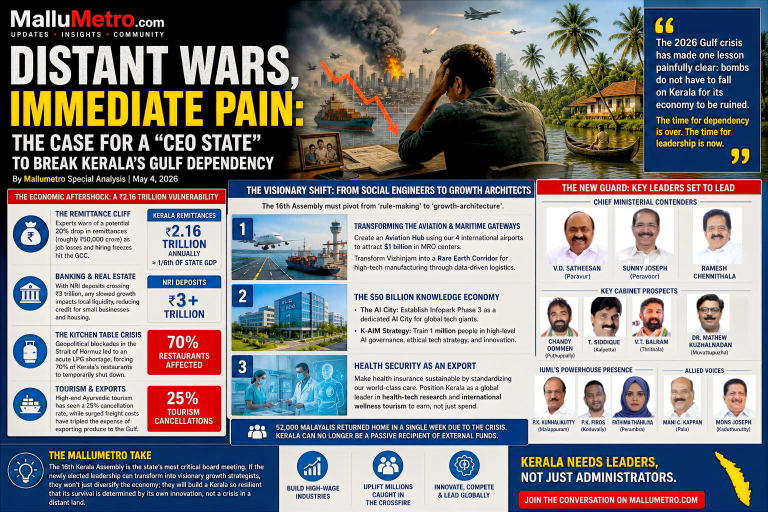
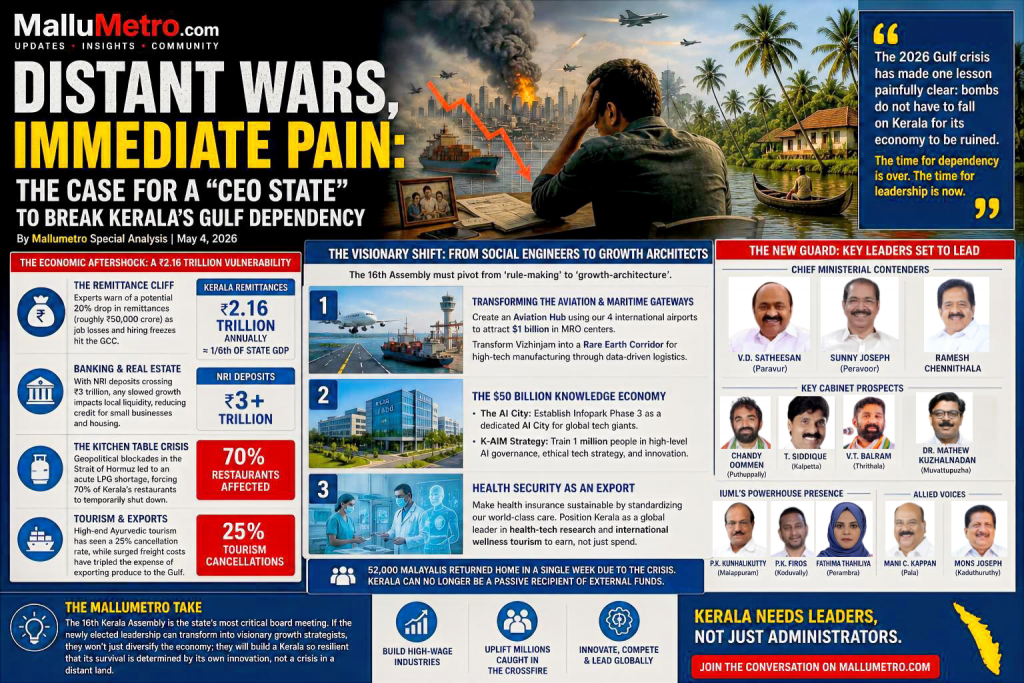
Kerala’s economy is structurally dependent on the Gulf like no other Indian state, receiving approximately ₹2.16 trillion annually in remittances—accounting for nearly one-sixth of the state’s total economy.
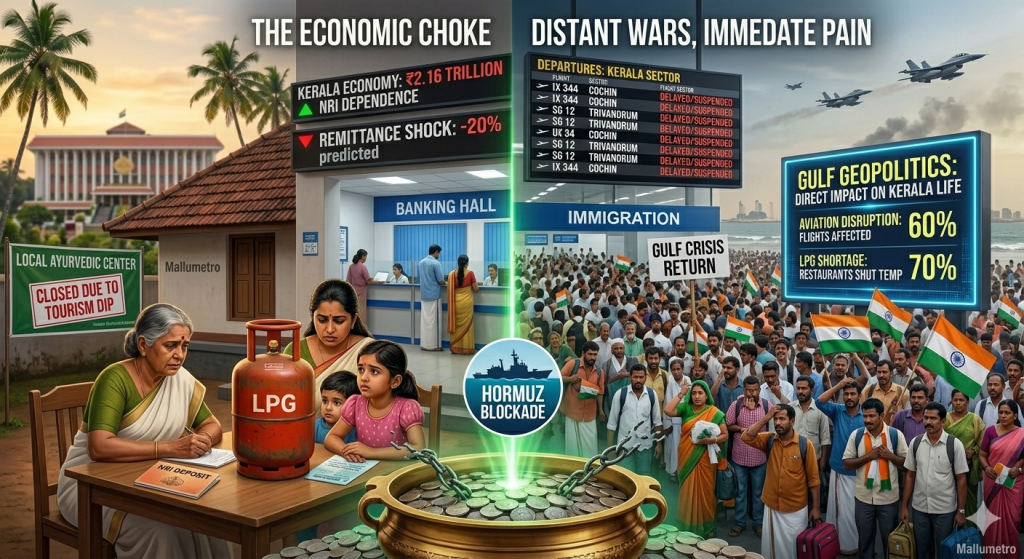
- The Remittance Cliff: Experts warn of a potential 20% drop in remittances (roughly ₹50,000 crore) as job losses and hiring freezes hit the GCC.
- Banking & Real Estate: With NRI deposits crossing ₹3 trillion, any slowed growth directly impacts local liquidity, reducing credit for small businesses and housing.
- The Kitchen Table Crisis: Geopolitical blockades in the Strait of Hormuz led to an acute LPG shortage, forcing 70% of Kerala’s restaurants to temporarily shut down earlier this year.
- Tourism & Exports: High-end Ayurvedic tourism has seen a 25% cancellation rate, while surged freight costs have tripled the expense of exporting Kerala’s produce to the Gulf.
The Visionary Shift: Transitioning from Social Engineers to Growth Architects
The historic mandate delivered on May 4, 2026, marks the beginning of an era that demands a new kind of leader: The Visionary CEO Politician. The recent crisis, which saw 52,000 Malayalis return home in a single week, proved that Kerala can no longer be a passive recipient of external funds.
The 16th Assembly must pivot from mere “rule-making” to “growth-architecture,” treating the state as a high-level strategic board focused on competitive global advantages.
1. Transforming the Aviation & Maritime Gateways
Instead of just building airports, visionary leadership must create an Aviation Hub. By leveraging the four international airports to attract $1 billion in maintenance, repair, and overhaul (MRO) centers, Kerala can turn transit land into a profit center. Similarly, the focus on Vizhinjam must shift from construction to data-driven logistics, transforming the area into a Rare Earth Corridor for high-tech manufacturing.
2. The $50 Billion Knowledge Economy
While basic digitization is complete, the “CEO State” must push toward a $50 Billion IT Economy.
- The AI City: Establishing Infopark Phase 3 as a dedicated AI City for global tech giants.
- K-AIM Strategy: Using the Kerala Artificial Intelligence Mission to train one million people not just in coding, but in high-level AI governance and ethical tech strategy.
3. Health Security as an Export
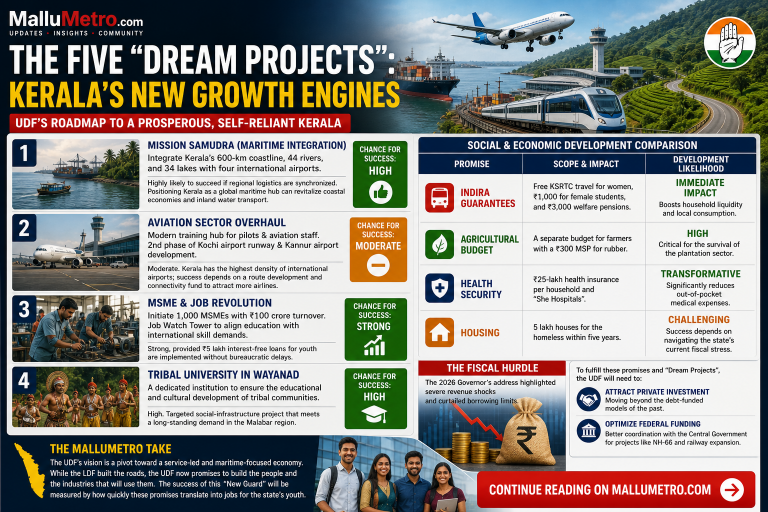
The promise of ₹25-lakh health insurance per household is only sustainable if the sector becomes a net earner. By adopting a business mindset, bureaucrats can standardize Kerala’s world-class care to attract global revenues through health-tech research and international wellness tourism.
The Mallumetro Take
The 2026 Gulf crisis has made one lesson painfully clear: bombs do not have to fall on Kerala for its economy to be ruined. The 16th Kerala Assembly is effectively the state’s most critical board meeting.
If the newly elected leadership can transform into visionary growth strategists, they won’t just diversify the economy; they will build a Kerala so resilient that its survival is determined by its own innovation, rather than a crisis in a distant land. The most urgent task is to look inward strengthening domestic high-wage industries and supporting the millions caught in the crossfire of a foreign war.