
DIFC’s continued expansion is more than a financial-centre headline. It can also show where new companies, specialist services and future career opportunities are starting to cluster in Dubai.
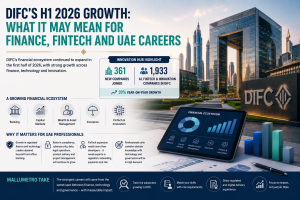
Dubai International Financial Centre said its financial ecosystem continued to grow during the first half of 2026, with activity across banking, capital markets, wealth and asset management, insurance, FinTech and innovation.
One of the most notable figures came from the Innovation Hub.
DIFC said 361 new companies joined the Hub, taking the number of AI, FinTech and innovation companies to 1,933, representing 39% year-on-year growth.
Why does this matter for jobs?
When finance and technology grow together, the opportunities are not limited to bankers or investment professionals.
Companies operating in regulated financial environments also need people in areas such as:
compliance, cybersecurity, data governance, legal operations, product delivery, project management, customer experience, risk and specialist professional services.
That is particularly relevant as financial firms use more cloud platforms, AI, automation and digital products while still operating under strict regulatory requirements.
FinTech growth needs more than developers
A growing FinTech company may certainly need software engineers.
But it may also need people who understand regulation, onboarding, payments, fraud prevention, data privacy, programme delivery, operations and customer experience.
The strongest candidates may therefore be those who can combine technology knowledge with an understanding of how regulated businesses actually operate.
What should jobseekers take from the numbers?
A strong DIFC growth announcement does not mean there will suddenly be jobs for everyone.
The more useful approach is to look at which parts of the market are expanding.
If wealth management, insurance, FinTech, AI and digital financial services continue growing, candidates should compare job descriptions in those areas and look for recurring skills.
That may include:
- financial-services or regulated-environment experience;
- cybersecurity or data governance;
- digital transformation;
- product or programme management;
- regulatory compliance;
- risk management; and
- measurable project delivery.
The key is not to add every fashionable keyword to a CV.
It is to show where your actual experience connects with what these companies need.
What about people coming from other sectors?
Some professionals may be able to move into the financial-services ecosystem without having spent their entire careers in banking.
Project managers, technology specialists, cybersecurity professionals, legal and compliance staff, data professionals and operations leaders may have transferable experience.
But the move becomes easier when candidates can demonstrate that they understand regulated environments, governance and the commercial context of financial services.
MalluMetro Take
The interesting signal from DIFC’s growth is the increasingly close connection between finance, technology and regulation.
For professionals, that means job titles alone may matter less than the combination of skills behind them.
Someone who understands a business domain, can work with technology, follows governance requirements and can show measurable delivery may be better positioned than someone relying only on a generic title.
The useful question is not simply “Is DIFC growing?” It is “Which skills are becoming more valuable as it grows?”