
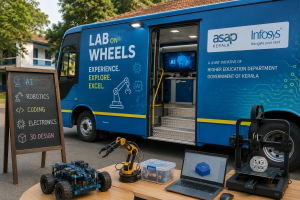
Where a student lives can still influence the kind of technology education they get. Kerala’s new “Lab on Wheels” initiative is trying to narrow that gap by taking the equipment directly to students.
Implemented by ASAP Kerala under the Higher Education Department in collaboration with Infosys, the project is described as Kerala’s first mobile experiential-learning laboratory.
The mobile lab will give students hands-on exposure to areas including artificial intelligence, robotics, coding, microcontrollers, electronics and 3D design.
Why the mobile model matters
The programme is intended to reach schools and colleges across urban, rural, coastal, tribal, hill and other remote communities.
Instead of expecting every institution to maintain a fully equipped technology laboratory, the mobile model allows equipment and training to travel between locations.
That could be particularly useful for students who hear regularly about AI, robotics and emerging technologies but have little opportunity to actually experiment with them.
There is a big difference between watching a video about robotics and building something yourself.
Practical exposure can also help students understand whether technology is something they genuinely enjoy before making decisions about higher education or careers.
Why Gulf Malayali families may want to watch this
For many Malayali families living in the Gulf, Kerala remains an important option for higher education.
Programmes that give students earlier exposure to practical digital skills could help strengthen the connection between school education, university choices and future employment.
But one mobile laboratory cannot solve every skills gap.
The longer-term value will depend on whether students get repeated access and whether the programme connects interested learners with further training, projects, competitions or mentors.
What to watch next
The most useful measures will be relatively simple:
How many schools and colleges does the programme reach? How much practical time does each student receive? And what happens after the mobile lab leaves?
If the first interaction leads students towards longer courses, projects or technology clubs, the impact could extend well beyond a single visit.
MalluMetro Take
The most valuable part of this initiative is not simply that students get to see new equipment.
It is the opportunity to build, test, make mistakes and discover what interests them.
Taking technology education to communities that may not otherwise have easy access is a practical first step. The bigger challenge will be turning that first exposure into continued learning.