
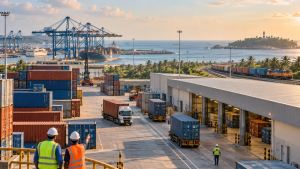
Vizhinjam’s development is moving beyond ships, cranes and quay operations. The next challenge is building the landside logistics network that allows cargo to move efficiently between the port, businesses and the wider transport system.
A dedicated Container Freight Station (CFS) is now being developed at the Travancore Spinning Mills premises in Balaramapuram, supporting the growing EXIM operations at Vizhinjam International Seaport.
The foundation stone for the project was laid on 16 September 2026, and Kerala State Industrial Enterprises Limited (KSIE) is implementing the facility as part of the state’s wider port-linked logistics programme. @theweek
The latest update is significant: KSIE told Indian Transport & Logistics News on 3 October that Phase I commercial operations and full Customs clearance are targeted to begin in March 2027, subject to completion of infrastructure, statutory approvals and operational readiness. Indian Transport & Logistics
What exactly is a Container Freight Station?
A CFS is not simply a place to park containers.
It functions as an off-dock logistics facility where export and import cargo can be consolidated, separated, examined, documented, stored temporarily and cleared through Customs before or after moving through the port.
Moving some of these activities away from the terminal can reduce pressure on valuable quayside space and allow containers to move through the port more efficiently.
For Vizhinjam, that becomes increasingly important as the port develops beyond transshipment and handles more cargo actually entering or leaving Kerala.
What is being built at Balaramapuram?
The first phase is being developed on the Travancore Spinning Mills property.
According to KSIE’s latest project update, it will include container yards, covered warehousing, Customs and operational offices, a weighbridge, cargo-handling equipment, fire and safety systems, controlled gate facilities and digital cargo-management systems. Indian Transport & Logistics
The facility is also planned to handle refrigerated containers, with electrical plug-in and monitoring infrastructure for temperature-sensitive cargo. That could become important for products such as food, seafood, pharmaceuticals and other cold-chain shipments. Indian Transport & Logistics
Initial Phase I capacity is currently expected to be around 1,000–1,500 TEUs per month, with the infrastructure designed for expansion as cargo volumes increase. Indian Transport & Logistics
Why digital integration matters too
One of the less visible but important parts of the project is its planned digital connection with the wider logistics chain.
KSIE says the CFS is expected to use Electronic Data Interchange (EDI) and electronic documentation linking the facility with Customs, shipping lines, freight forwarders, transport operators and Vizhinjam Port.
The objective is to allow container identification, gate movements, cargo status and clearance processes to be tracked electronically rather than relying heavily on disconnected manual processes. Indian Transport & Logistics
For exporters and importers, this part may ultimately matter as much as the physical container yard.
A second logistics facility is also being planned
The Balaramapuram CFS is not intended to stand alone.
KSIE is also planning a second-stage facility on property belonging to Kerala Automobiles Limited (KAL).
That site is expected to function primarily as an empty-container yard, including container receipt, storage, inspection, cleaning and minor maintenance. Indian Transport & Logistics
The Kerala government had already granted in-principle approval for KSIE to establish the CFS and allied logistics facilities in association with Travancore Spinning Mills and Kerala Automobiles Limited. Kerala Automobiles
Together, the two sites begin to show how the logistics ecosystem around Vizhinjam could expand beyond the port boundary.
How this differs from MalluMetro’s earlier Vizhinjam coverage
MalluMetro previously covered the start of EXIM cargo operations at Vizhinjam.
This is the next part of that story.
A port can receive some of the world’s largest container ships, but that alone does not create an efficient gateway for Kerala’s exporters and importers.
Cargo still needs:
Customs clearance, warehousing, container handling, road and rail connections, freight-forwarding services and reliable movement between the port and its hinterland.
The CFS addresses one part of that chain.
The railway connection makes Balaramapuram more interesting
Balaramapuram is also significant because the planned Vizhinjam–Balaramapuram rail connection is intended to connect the port with India’s wider railway network.
The proposed rail link is around 10.7 km, much of it planned underground, and has been included in the PM Gati Shakti National Master Plan. Land-acquisition activity for the connection has also been progressing. Keralakaumudi
That does not mean the CFS and railway will immediately function as one integrated system.
But geographically, the combination of port, freight station, road access and future rail connectivity makes the Balaramapuram corridor worth watching closely.
What should we watch next?
The important milestones are no longer simply announcements.
What matters now is whether March 2027 operations are achieved, when Customs approval is secured, how quickly container volumes grow, whether the KAL empty-container yard proceeds, and how effectively the facility connects with road and eventually rail movement.
MalluMetro Take
Vizhinjam’s biggest long-term test will not be how many giant ships appear in photographs.
It will be how easily cargo moves after those ships arrive.
The Balaramapuram Container Freight Station is therefore important precisely because it is less spectacular than the port itself.
Warehouses, Customs processing, empty-container yards, digital documentation, trucks and rail links are the infrastructure that can turn a successful container terminal into a functioning trade gateway.
The ships make Vizhinjam visible. The landside logistics network will determine how useful it becomes to Kerala’s economy.
Verified sources
Kerala Government Industries Department; Kerala State Industrial Enterprises project information; Indian Transport & Logistics News, 3 October 2026; Kerala government planning and transport documents.