
Saudi Arabia’s rail ambitions are increasingly measurable not only in kilometres of new infrastructure, but in how many people and how much freight the network is actually moving.
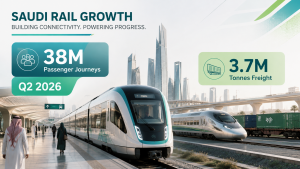
More than 38 million passenger journeys were recorded across Saudi rail systems during the second quarter of 2026, according to the Transport General Authority.
During the same three months, railways transported around 3.7 million tonnes of minerals and goods, along with 47,000 standard containers.
For residents and businesses, those usage numbers may tell a more useful story than another announcement about what will eventually be built.
Riyadh Metro dominates urban rail use
Urban rail accounted for around 36 million passenger journeys during the quarter.
The largest share came from the Riyadh Metro, with 29.7 million passengers.
Other urban systems also recorded significant use:
- Al-Mashaaer Metro: 1.9 million passengers
- King Abdulaziz International Airport automated people mover: around 3.9 million
- Princess Nourah bint Abdulrahman University people mover: around 635,000
The Riyadh figure is particularly significant because it shows how quickly a major new public-transport network can become part of everyday travel when it connects the right destinations.
Intercity rail is carrying substantial numbers too
The Haramain High Speed Railway carried around 1.6 million passengers during the quarter.
The route links Makkah and Madinah through Jeddah, King Abdulaziz International Airport and King Abdullah Economic City.
Meanwhile, the Eastern Train carried approximately 389,000 passengers, while the Northern Train recorded around 246,000.
Those services serve a different role from city metros: they connect major population centres, airports and economic regions over much longer distances.
Rail is also an important freight story
Passenger numbers attract attention, but Saudi Arabia’s railway system is also moving large volumes of cargo.
During Q2, the SAR North network transported about 3.3 million tonnes of goods, while the Eastern network moved another 396,000 tonnes.
A further 47,000 standard containers were transported by rail.
That matters because shifting suitable freight onto rail can strengthen connections between ports, industrial areas, mines, logistics centres and inland markets.
For businesses, the value of rail is therefore not only faster passenger movement. It can also be about more efficient supply chains.
Why should the wider Gulf pay attention?
Saudi Arabia’s numbers offer a useful signal for a region investing heavily in public transport and logistics.
For decades, Gulf cities have depended heavily on roads and private vehicles. Increasing rail use shows another model beginning to establish itself — particularly for high-volume urban travel and long-distance freight.
But Saudi Arabia’s Q2 figures should not be confused with evidence that a fully interconnected GCC passenger-rail network already exists.
That regional story will depend on separate projects and future cross-border connections.
MalluMetro Take
The most interesting number is not simply 38 million.
It is what sits underneath it: nearly 30 million Riyadh Metro journeys, millions more on other urban systems, substantial intercity use and millions of tonnes of freight moving by rail.
Saudi Arabia’s rail transition is therefore becoming something that can be measured through actual use rather than future promises.
For transport projects across the Gulf, that may increasingly be the better test:
not how many kilometres were announced, but how many people and how much freight the completed network actually moves.