
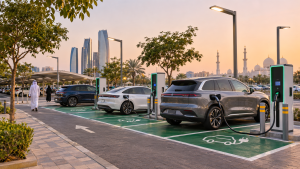
Electric-vehicle drivers in Abu Dhabi now have access to a newly commissioned public charging network integrated into Mawaqif parking areas, with 332 charging points already activated in the first phase.
Abu Dhabi Mobility announced that 244 charging units providing 332 charging points have been brought into operation as part of the new network, developed in collaboration with Q Mobility and private-sector operators.
The chargers are being installed in public parking areas regulated under the Mawaqif system, allowing EV drivers to charge while using designated parking bays.
How large is the first phase?
The 332 active charging points are only the beginning.
The first phase of the project is planned to provide:
1,000 charging units
across 405 locations
in 10 main areas
covering Abu Dhabi City, Al Ain City and the Al Dhafra Region.
The network includes both standard and fast charging options.
Standard chargers are rated at 22 kW, while fast chargers range from 60 kW to 160 kW.
How can drivers use the chargers?
Abu Dhabi Mobility says drivers can scan the QR code displayed on the charging unit.
That directs the user to the application designated for that particular charging area.
Through the relevant app or information displayed on the charger, users can:
- locate a charging station;
- check whether the connector is compatible with their vehicle;
- review the approved charging tariff;
- follow charging instructions; and
- access technical-support contact details.
This is important because the charging network is being operated through multiple partners rather than one single universal charging application.
Do Mawaqif parking charges still apply?
Yes.
The official announcement states that standard Mawaqif public-parking fees continue to apply to the charging bays.
EV charging is charged separately according to the tariffs approved by the charging-station operator.
Drivers should therefore check both:
the charging tariff and
the applicable Mawaqif parking charge
before starting a session.
Charging bays are not ordinary parking spaces
The designated EV charging spaces are intended specifically for vehicles that are actively charging.
Abu Dhabi Mobility says vehicles must leave the charging bay immediately after charging is complete so other EV users can access the charger.
That means a charging bay should not be treated as ordinary long-term parking simply because the vehicle is electric.
Who is operating the network?
The charging project is being delivered using a public-private partnership model.
The official announcement names:
ChargePoint, Tatweer Middle East & Africa and Loop Global
among the companies involved in deploying and operating the charging infrastructure.
The concession model covers the supply, installation, operation and maintenance of the charging equipment.
How large could the network become?
Abu Dhabi’s target extends well beyond the current first phase.
By 2032, the project aims to provide:
4,500 charging units
more than 9,000 charging points
across approximately 2,250 locations
throughout the Emirate of Abu Dhabi.
That would substantially expand the availability of public EV charging in Abu Dhabi City, Al Ain and Al Dhafra.
Is every Mawaqif car park equipped with a charger?
No.
The headline network totals should not be interpreted as meaning that every public car park has an EV charger.
Abu Dhabi Mobility has announced the total number activated and the wider rollout plan, but drivers should still verify the exact charger they intend to use before travelling.
Do not assume that a particular Mawaqif parking area has a charger simply because the network is now operational.
What should EV drivers check before setting out?
Before depending on a public charger, check:
- the exact charging location;
- whether the charger is operational;
- connector compatibility;
- charging speed;
- the operator’s tariff;
- the required app or payment method; and
- the applicable Mawaqif parking charge.
The QR code on each charging unit is designed to direct drivers to the correct application and operating information for that location.
Why does this matter for Abu Dhabi EV owners?
One of the practical barriers to owning an electric vehicle is access to charging away from home.
Integrating chargers into the existing public-parking network makes it easier for drivers to charge during everyday activities rather than making a separate trip to a dedicated charging hub.
Abu Dhabi Mobility says the project supports its wider Low and Zero-Emission Vehicle Strategy and the transition towards cleaner transport.
The authority is also developing digital services intended to help drivers locate charging stations, monitor charging sessions and make payments.
MalluMetro Take
The useful part of this announcement is that the network is no longer only a future plan.
332 public charging points have already been activated.
But drivers should also keep the scale in perspective.
This is the beginning of a much larger rollout, not universal charger coverage across every Mawaqif parking area.
For an EV driver, the practical approach is:
find the charger first, confirm compatibility and availability, check the charging tariff and remember that normal Mawaqif parking charges still apply.
The longer-term target — more than 9,000 charging points across roughly 2,250 locations by 2032 — shows how much larger Abu Dhabi intends the network to become.
Verified source: Abu Dhabi Mobility / Integrated Transport Centre announcement, 10–11 November 2026. Status reviewed 13 November 2026.