
Sometimes a community moment becomes memorable precisely because nobody appears to have planned it as a major announcement.
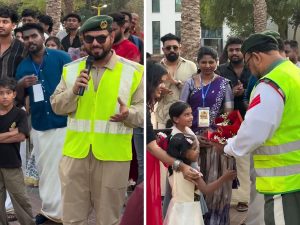
During Onam celebrations in Dubai’s Karama area, Dubai Police officers joined members of the Malayali community as residents gathered for the festival.
Video of the interaction quickly attracted attention online, with officers seen engaging with people at the celebration rather than simply observing from a distance. Gulf News reported that the footage was shared by local community account Ente Karama, while Malayala Manorama separately reported the officers’ participation at the Karama Park gathering.
The moment itself was simple.
That may be exactly why people connected with it.
Why did the video resonate?
Onam is deeply familiar to Malayalis.
But celebrating it thousands of kilometres from Kerala gives the festival another dimension.
Children may grow up speaking English or Arabic at school, parents may spend most of their adult lives in the UAE, and families may celebrate Onam in an apartment, park or community hall rather than the place where their parents grew up.
Seeing local police officers comfortably step into that celebration sends a subtle message:
the culture people bring with them can still have a visible place in the city where they now live.
That is more meaningful than a viral-video statistic.
A multicultural city is built through ordinary encounters
Dubai’s diversity is often described through large numbers — nationalities, tourists, international companies and global events.
But multicultural life is also built through much smaller encounters.
A neighbour tasting Onasadya for the first time.
A colleague asking about the pookalam.
A child explaining Onam to a school friend.
Or, in this case, police officers spending time with residents during their community celebration.
Those moments can make cultural difference feel ordinary rather than separate.
This was a community gathering, not an official government festival
That distinction is worth keeping clear.
The available reporting describes Dubai Police officers joining an existing Malayali community celebration. The widely circulated footage originated from the Ente Karama social-media account; it was not presented as an official Dubai Police announcement launching an Onam event.
That does not make the moment less valuable.
In some ways, the informal nature of the interaction is what made it appealing.
Why Gulf Onam keeps extending beyond one date
For Malayalis in the Gulf, Onam rarely fits perfectly into the festival calendar.
Work shifts, school schedules, venue availability and weekends mean celebrations can happen before or after Thiruvonam.
So Onam appears across homes, parks, schools, offices, associations and community halls, often over several weeks.
That flexibility is part of how the festival has adapted to expatriate life.
MalluMetro Take
The Karama video mattered not because Dubai Police became part of an official Onam programme.
It mattered because the interaction looked normal.
A community celebrated its festival. Local officers joined them. People smiled, recorded the moment and carried on celebrating.
For families raising children outside Kerala, perhaps that is one of the healthiest forms of cultural belonging:
keeping a connection to where your family comes from while also feeling fully at home in the country where you live.