
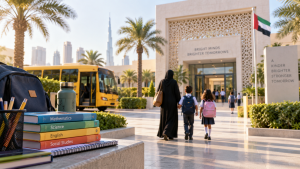
More than 1.277 million students have returned to classrooms across the UAE, but the 2026–27 academic year brings more than a new timetable and fresh textbooks.
Schools reopened on 31 August 2026, with more than 1,180 public and private schools welcoming students for the new year. The Ministry of Education also reported 26,700 new registrations in public schools.
For families, some of the most noticeable changes are happening in homework, assessment, project-based learning and early-language development.
More schools, buses and textbooks
For the new academic year, the Ministry opened 11 new schools and educational complexes, deployed 5,810 school buses and distributed around eight million textbooks.
Those national figures do not mean every household will have the same arrangements.
Private-school transport, textbooks, devices and curriculum requirements can differ, so parents should continue treating their own school as the final source for everyday instructions.
No traditional homework for the youngest students
One of the biggest changes announced by the Ministry is the removal of traditional homework for students from Kindergarten through Grade 2.
Instead, the new approach places greater emphasis on daily reading at home, with the aim of supporting literacy and cognitive development while improving the balance between school and family life.
Parents in private schools should still confirm exactly how the policy applies within their child’s curriculum and school.
Assessment is changing too
For Cycle 3 Group A subjects, the Ministry has adjusted the weighting between school-based and central assessments to a 50/50 split.
Teacher-led diagnostic tests are also being introduced to identify learning gaps earlier and help schools plan targeted support.
At the same time, the Project-Based Learning and Assessment initiative is expanding to more than 129,000 students across 366 schools.
A new integrated Grade 7 project brings together Arabic, English, mathematics and science, with the aim of connecting classroom knowledge to practical application.
Arabic assessment is expanding in Grade 1
The second phase of the Arabic-language skills assessment now targets around 19,000 Grade 1 students in 162 public schools and another 11,000 students across 130 private schools.
The aim is to establish early skill levels and identify where additional support may be needed.
School-zone safety received extra attention
Ahead of reopening, Dubai Police trained more than 140 security guards across 35 schools in traffic control, minor-accident response, safe bus boarding and student safety around school premises.
That is a reminder that the return to school affects roads as much as classrooms — particularly during morning drop-off and afternoon pickup periods.
Dates parents should save
The Ministry’s 2026–27 calendar currently lists the academic year ending on 2 July 2027. Winter and spring breaks, as well as mid-term arrangements, vary somewhat depending on curriculum and the relevant education authority, particularly for some private schools.
Parents should therefore use the national calendar as the broad framework but confirm exact dates with their school.
MalluMetro Take
The start of a school year is easy to reduce to uniforms, buses and stationery.
But some of the more important changes this year are happening inside the classroom:
less traditional homework for younger children, more diagnostic assessment, greater use of project-based learning and stronger attention to early language development.
For parents, the useful approach is simple:
follow national education updates for the big picture — but treat your child’s own school as the final source for homework, transport, assessment and daily routines.