
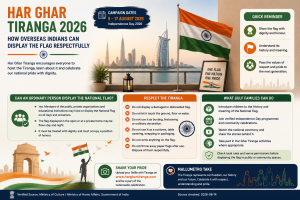
Har Ghar Tiranga is back for Independence Day 2026, encouraging Indians to bring the Tiranga home, understand what it represents and celebrate the national flag with dignity.
This year’s campaign runs from 9 to 17 August 2026. The Government of India is encouraging citizens to hoist the National Flag and participate in activities connected with the Tiranga and Independence Day.
For Indians living in the Gulf, participation does not need to mean covering a home or workplace in tricolour decorations.
A single National Flag, displayed correctly and respectfully, can be far more meaningful.
Can an ordinary person display the Tiranga?
Yes.
The Ministry of Home Affairs says members of the public, private organisations and educational institutions may hoist or display the National Flag on all days and occasions, provided it is treated with dignity and honour.
The Flag Code was also amended in 2022 so that when the flag is displayed in the open or at the home of a member of the public, it may be flown during the day and at night.
A few rules worth remembering
The National Flag should be given a position of honour and should not be displayed if it is damaged or dishevelled.
It should also not:
- touch the ground, floor or water;
- be displayed upside down;
- be used as festooning, bunting or ordinary decoration;
- be used to wrap or carry items; or
- have writing placed on it.
Paper flags used during celebrations should not simply be thrown on the ground afterwards. Government guidance says they should be disposed of privately and respectfully.
What can Gulf families do?
For families abroad, Har Ghar Tiranga can be an opportunity to explain the flag rather than simply display it.
Children can learn about the three colours, the Ashoka Chakra, the history of the National Flag and why there are rules protecting its dignity.
Families may also participate in verified Independence Day programmes or use the official Har Ghar Tiranga activities where appropriate.
If displaying a flag at a workplace, residential building or public venue in the Gulf, also check local rules and building or venue permissions before putting anything up.
A good lesson for children
Rather than telling children simply to “respect the flag”, explain why.
The Tiranga represents a country, its people, its history and the freedoms inherited by later generations.
Understanding that meaning is likely to stay with a child much longer than another Independence Day photograph.
MalluMetro Take
Har Ghar Tiranga works best when the flag is more than a backdrop for a selfie.
Display it correctly. Understand what it represents. Treat it with dignity.
For Indian families living abroad, that can also turn Independence Day into something valuable for the next generation — a connection with home that is based not only on emotion, but on understanding.