
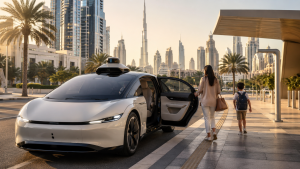
A driverless taxi in Dubai is no longer only something you might see being tested on the road. In selected areas, residents can now actually be matched with one through Uber.
Dubai’s Roads and Transport Authority says Robotaxi operations have passed 4 million kilometres, with 7,613 passenger journeys completed since launch.
The programme currently involves 144 vehicles, of which 48 are in active operation, completing around 50 trips a day. RTA also reports customer satisfaction of 97%.
Those numbers show substantial testing and operating experience — but they also show that autonomous taxis are still being introduced gradually.
What has actually changed?
The most significant development is not the four-million-kilometre figure.
It is that fully driverless Apollo Go Robotaxis are now officially available through the Uber app in selected parts of Dubai. New Horizon Luxury Transport operates the fleet.
That moves autonomous transport closer to the way residents already use taxis.
Instead of joining a technology trial or using a specialist demonstration service, some passengers can now encounter a driverless vehicle through a familiar ride-hailing platform.
Does booking Uber mean you will get a robotaxi?
No.
The service operates within defined geographic zones, and RTA is expanding autonomous operations through a phased safety process.
So a passenger should not assume that every Dubai journey — or even every Uber journey — can currently be completed without a driver.
With 48 vehicles actively operating and around 50 trips being completed each day, the service remains relatively small compared with Dubai’s conventional taxi and ride-hailing network.
That is an important distinction.
Dubai has moved from “Can this technology work here?” towards “How can it work reliably at scale?”
It has not yet reached “Robotaxis are everywhere.”
Why have they travelled so far compared with passenger trips?
The difference between 4 million kilometres travelled and 7,613 passenger journeys is worth explaining.
RTA’s programme has been developed through extensive testing in real-world conditions, initially using safety-driver trials before moving towards fully driverless public operation. The accumulated distance therefore provides operational data for evaluating autonomous-driving performance, reliability and safety — it should not be interpreted simply as passenger mileage.
For autonomous vehicles, those kilometres matter because the system has to learn to deal reliably with everyday situations such as lane changes, junctions, surrounding traffic and unpredictable road behaviour.
What should passengers judge?
For residents, the technology itself may eventually become less interesting than the experience.
The useful questions will be:
- How long does a Robotaxi take to arrive?
- Which neighbourhoods can it serve?
- How does the fare compare with a conventional taxi?
- Is boarding easy for families, older passengers and people of determination?
- What happens if something unusual occurs during the journey?
- And does the vehicle reliably get passengers where they need to go?
Those everyday details will determine whether autonomous taxis become a serious transport option rather than simply an impressive technology.
Robotaxis are one piece of a larger system
Dubai’s target is for 25% of all transportation trips to be autonomous by 2030.
RTA is working not only with Baidu’s Apollo Go but also with WeRide and Pony.ai, as Dubai develops a broader autonomous-mobility ecosystem.
Robotaxis are therefore expected to sit alongside the Metro, buses, conventional taxis and other shared-mobility services rather than replacing everything at once.
That distinction matters.
A driverless taxi may eventually be particularly useful for the journey between a home or workplace and a Metro station — one part of a larger public-transport trip.
MalluMetro Take
The milestone is not simply that Dubai’s Robotaxis have travelled four million kilometres.
The more meaningful change is that fully driverless vehicles have started entering the same digital booking system residents already use for ordinary journeys.
But this remains an early stage.
With selected operating zones, 48 active vehicles and around 50 journeys per day, Dubai is still learning what happens when autonomous driving moves from controlled testing into everyday mobility.
The real test will come as the technology becomes less remarkable.
When passengers stop choosing a Robotaxi because it is driverless — and start choosing it simply because it is convenient, reliable and affordable — autonomous mobility will truly have entered daily life.