
Electricity substations rarely attract attention. They do not have the visibility of a new Metro station or landmark bridge. But when hundreds are being added in just six months, they reveal something important about how quickly the city is expanding.
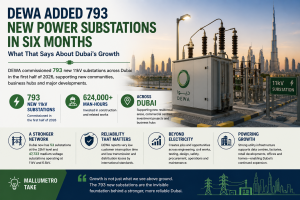
Dubai Electricity and Water Authority says it commissioned 793 new 11kV substations across Dubai during the first half of 2026.
The related works involved more than 624,000 man-hours.
Why does Dubai need so many substations?
New homes, offices, shopping areas, business hubs and major developments all need more than roads and buildings.
They also need dependable electricity.
As new areas are built and occupied, the power network has to expand with them. Local substations help distribute electricity closer to where it is actually being used.
DEWA linked the latest expansion to new residential areas, commercial centres, investment projects and business hubs.
In other words, these substations are part of the infrastructure that quietly arrives alongside visible urban growth.
How large is Dubai’s network now?
DEWA says Dubai now has 53 substations at the 33kV level and 47,723 medium-voltage substations operating at 11kV and 6.6kV.
Those numbers may sound technical, but the practical point is simple: the city is adding capacity while trying to maintain a reliable network.
Residents usually notice electricity infrastructure only when something goes wrong.
Good performance is often the result of planning, maintenance and network expansion that happens long before demand reaches its peak.
What does this mean beyond electricity?
Utility expansion also creates work across a much wider range of industries.
That can include electrical engineering, civil works, testing and commissioning, design, protection systems, project controls, safety, procurement and maintenance.
For businesses, the significance is even broader.
Data centres, factories, offices, retail developments and residential towers all depend on reliable power capacity. Growth in those sectors is difficult without the supporting electricity network already in place.
What should residents take from this?
The announcement does not mean every part of Dubai is growing at the same speed, and it should not be treated as a signal about future property prices.
What it does show is that utility infrastructure is being expanded in parallel with the city’s wider development.
That matters because the most visible parts of growth — buildings, roads and new communities — only work when the systems behind them are ready too.
MalluMetro Take
Dubai’s growth is easy to see in cranes, roads and new developments.
The less visible part is the infrastructure underneath them.
The addition of 793 new substations in six months is a reminder that a growing city depends just as much on reliable utilities as it does on architecture and transport.
The real sign of successful growth is not only what gets built, but whether the systems supporting it can keep up.