
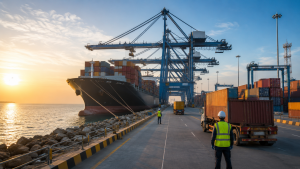
Vizhinjam International Seaport has entered a new phase. It is no longer functioning mainly as a place where containers move from one international vessel to another – Kerala businesses can now begin using the port for their own export-import cargo.
EXIM operations officially began at Vizhinjam on 18 August 2026, when the first export containers were flagged off from the deep-water port.
For people outside the shipping industry, the distinction matters.
Transshipment means containers arriving on one ship and being transferred to another.
EXIM cargo connects the port directly with businesses importing goods into India or exporting Indian products overseas.
That makes Vizhinjam potentially much more relevant to Kerala’s own economy.
What actually changed?
The first EXIM movement began with export containers carrying Kerala food products.
The operational launch means exporters can start using Vizhinjam as a gateway to international markets rather than relying entirely on cargo movements through other ports or overseas transshipment hubs.
The port already has direct regular and ad-hoc shipping connections to more than 110 major ports across 50 countries on six continents, according to information published around the EXIM launch.
That connectivity is one of Vizhinjam’s biggest potential advantages.
But the real test will be whether Kerala exporters can use those connections reliably and competitively on a regular basis.
The road connection matters almost as much as the port
A deep-water harbour is only one part of a logistics system.
Containers still have to reach the port from factories, farms, warehouses and distribution centres — and imports have to move in the opposite direction.
The Kerala Government confirmed that the temporary connection between Vizhinjam and National Highway 66 has been completed.
Permanent road and rail connectivity will remain important because the value of a port depends heavily on how quickly and cheaply cargo can move between the quay and the wider economy.
Why this could matter for Kerala businesses
Vizhinjam’s opportunity extends beyond shipping companies.
Regular EXIM activity can create demand around:
freight forwarding, customs clearance, trucking, warehousing, cold storage, container handling, equipment maintenance, safety, digital logistics and supply-chain management.
Agriculture and food products are particularly interesting because Kerala produces goods that could benefit from faster and more predictable access to overseas markets.
The government’s wider plans around Vizhinjam also envisage logistics parks, warehousing, container facilities and industrial development connected with the port.
Mission Samudra widens the story
The EXIM launch was accompanied by Mission Samudra, a broader state initiative aimed at connecting port activity with logistics, industry and maritime development across Kerala.
That is significant because ports create their greatest economic impact when businesses begin locating and investing around them.
But those ambitions should be judged by actual delivery – infrastructure completed, businesses established, cargo handled and jobs created – rather than announcements alone.
What should we watch next?
The next important figures will be:
- how much regular Kerala-origin export cargo moves through Vizhinjam;
- when import volumes begin building;
- which shipping services provide dependable EXIM connections;
- progress on permanent road and rail links;
- warehousing and logistics development around the port; and
- whether logistics costs and transit times actually improve for businesses.
Those indicators will tell us much more than another ceremonial vessel call.
MalluMetro Take
Vizhinjam’s EXIM launch matters because the port is beginning to connect more directly with Kerala’s own businesses and supply chains.
Transshipment established Vizhinjam as a major maritime location.
EXIM cargo could determine how much of that advantage reaches the wider state economy.
For Gulf Malayalis working in shipping, logistics, engineering, construction and supply chains, this is worth following closely – because the opportunities around a major port often develop gradually, long after the first container has moved.
The next chapter of Vizhinjam will be measured not only by ships arriving, but by how effectively Kerala’s goods and businesses connect with the world.