
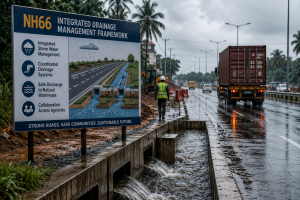
A highway can have new asphalt, wider lanes and modern flyovers – and still create problems if heavy rain has nowhere to go.
That is why a relatively technical Kerala Government decision on drainage along NH66 deserves attention.
On 11 August 2026, the Kerala Public Works Department issued G.O.(Rt) No. 912/2026/PWD, approving a policy framework for an integrated drainage management system for NH66.
For residents, the significance is simple: in Kerala’s monsoon climate, managing water can be just as important as building the road itself.
Why is drainage such a big issue on NH66?
Kerala combines intense seasonal rainfall with dense development, local roads, canals, culverts, existing drains and natural watercourses.
A major highway can change the way rainwater moves through an area.
If one drainage section is improved but the water has nowhere suitable to discharge, the problem may simply move somewhere else.
That is why drainage needs to be considered as a connected system, rather than as isolated concrete drains beside individual road sections.
What does “integrated” mean in practice?
The Government Order confirms approval of an integrated drainage-management policy framework for NH66.
The practical principle behind such an approach is straightforward: highway drainage has to work with the wider environment around it.
That can involve considering culverts, roadside drainage, adjoining local networks, natural water paths and suitable discharge points together.
The important next step, however, is implementation.
A policy framework by itself does not mean waterlogging problems along the entire highway have suddenly been solved.
What should residents watch now?
The useful questions come after the approval:
Which recurring flooding or waterlogging locations will be addressed first?
How will drainage across highway and adjoining areas be coordinated?
Who will be responsible for maintenance once systems are completed?
And will problem locations be monitored after heavy monsoon rainfall to see whether the intervention actually works?
Those answers will matter far more to residents than the wording of the Government Order itself.
Why drainage protects the highway too
Good drainage is not only about keeping water away from nearby homes.
Standing and uncontrolled water can damage road structures, shoulders and surrounding infrastructure over time.
So drainage investment also helps protect the money already being spent on NH66.
For motorists, the visible benefit may eventually be fewer flooded sections and safer travel during heavy rainfall.
For nearby communities, the more important benefit is avoiding a situation where faster road infrastructure unintentionally creates new water problems.
MalluMetro Take
Road projects are usually photographed from above – new lanes, bridges and interchanges.
Drainage rarely makes the promotional picture.
But during a Kerala monsoon, it can determine whether the entire system works.
The approval of an integrated NH66 drainage framework is therefore worth following, but the real test begins now:
Which problem locations are fixed, how well the connected drainage systems are maintained, and what happens when the next period of heavy rain arrives?
A highway should not be judged only by how quickly vehicles can move across it.
It should also be judged by how well the infrastructure works when the weather is at its worst.