
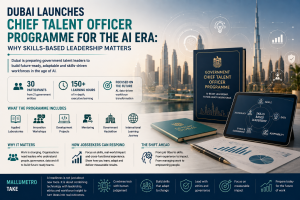
Dubai is preparing government HR and talent leaders for a workplace being reshaped by AI, data and changing skills – not just new technology.
The Government Chief Talent Officer Programme brings together 30 participants from 21 government entities and is designed to help senior talent leaders manage workforce transformation more effectively.
According to Dubai Government Human Resources, the programme includes more than 150 learning hours, applied laboratories, development projects, innovation workshops, mentoring, a government hackathon and an international learning journey.
Why this matters beyond government HR
At first glance, this may sound like a specialist programme for senior HR professionals.
But the bigger idea is relevant to almost anyone building a career in the UAE.
As AI changes how work is done, organisations increasingly need to understand what skills they already have, what capabilities they are missing and how employees can adapt to new roles and technologies.
That makes workforce planning less about filling vacancies and more about preparing people for work that may look different in a few years.
Job titles may tell less of the story
A person’s title does not always explain what they can actually do.
Two people with the same title may have very different abilities in areas such as data, project delivery, automation, stakeholder management or digital tools.
For professionals, this means it is increasingly useful to show specific skills and results, rather than relying only on seniority or job titles.
Instead of simply saying:
“Managed a project team.”
It is more useful to explain what changed:
“Introduced a digital reporting process that improved visibility of project risks and reduced manual reporting time.”
That kind of evidence makes capability easier to understand.
What should professionals do?
The answer is not to collect every new AI certificate that appears online.
Start by looking at your existing work.
Which tasks could AI or automation help you perform faster?
Which parts still depend heavily on judgement, communication, leadership, negotiation or accountability?
Then focus your learning on areas that genuinely strengthen your role.
For some people that may mean AI tools. For others it could be data analysis, cybersecurity, project governance, digital transformation or people leadership.
The useful combination is usually technical knowledge plus the ability to apply it in real work.
AI still needs human judgement
Technology can analyse data, automate repetitive tasks and help teams make faster decisions.
But organisations still need people who can decide what should be automated, recognise risks, communicate change and remain accountable for outcomes.
That is why leadership development remains important even as AI capability grows.
MalluMetro Take
AI readiness is not simply about knowing how to use the latest tool.
It is about understanding where technology helps, where human judgement still matters and how the two can work together.
For professionals, the strongest preparation may be to build skills that are useful across both sides of that equation: digital capability, communication, governance and measurable delivery.
The future of work is unlikely to belong only to people who know AI. It will favour people who know how to use it responsibly to get better results.