
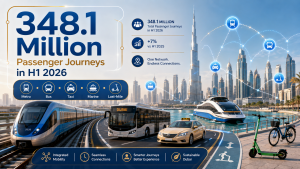
Dubai’s public transport story is no longer just about the Metro. Increasingly, it is about whether trains, buses, taxis, marine transport and last-mile services can work together well enough to make leaving the car at home practical.
Dubai’s Roads and Transport Authority says public transport, shared mobility and taxis recorded around 348.1 million passenger journeys in the first half of 2026.
The number is impressive. But for residents, the more interesting question is what that growth means for everyday travel.
The connection between services matters
Dubai now has several ways to move around the city: Metro, Tram, public buses, marine transport, taxis, ride-hailing services, shared mobility and bus-on-demand services.
Individually, each solves only part of a journey.
A Metro station becomes much more useful when there is a reliable bus connection nearby. A bus route becomes more attractive when the walk to the stop is safe and comfortable. And a public-transport journey becomes far easier when the last kilometre can be completed without another long wait.
That is why integration may matter more to commuters than simply adding another transport mode.
Why rising ridership matters
For a city that continues to grow, moving more people without putting all of them into individual cars is increasingly important.
Public transport can also give households more flexibility.
A family may still need a car for school runs or certain work journeys, but that does not mean the car needs to be used for every trip.
For some journeys, the calculation may favour public transport once fuel, parking, Salik, traffic and driving time are taken into account.
That is particularly true for trips into busy commercial districts, airports, major events and areas already well connected to the Metro.
Dubai wants public transport to take a bigger share
RTA’s longer-term strategy aims to increase the proportion of journeys made through public and shared transport.
That means new Metro lines, buses, cycling infrastructure, pedestrian connections and first-and-last-mile services should not be viewed as separate projects.
They are pieces of the same network.
A new Metro station, for example, becomes far more valuable if residents can reach it conveniently from surrounding communities.
A useful test for commuters
Instead of asking simply “Is there a Metro near me?”, compare the complete journey.
Look at:
- door-to-door travel time;
- walking and waiting time;
- parking costs;
- fuel and Salik;
- frequency of the return service; and
- how you will cover the first and last part of the journey.
For some routes, driving will still make more sense.
For others, Dubai’s expanding transport network may already be more convenient than people assume.
MalluMetro Take
The most important transport improvement is not always a faster train or another bus.
It is when the whole journey becomes easier.
Dubai’s growing passenger numbers suggest that more journeys are reaching that point — where Metro, buses, taxis and last-mile options work together well enough for residents to choose them instead of automatically taking the car.