
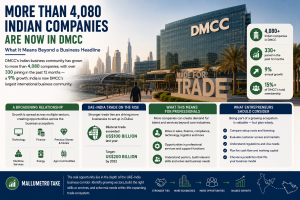
More than 4,000 Indian companies operating from one Dubai business district is an impressive number. But for professionals and entrepreneurs, the more useful question is what those businesses are actually doing — and where opportunities may be forming around them.
DMCC says its Indian business community has grown to more than 4,080 companies, after over 330 Indian businesses joined during the previous 12 months.
That represents 9% annual growth, making India DMCC’s largest international business community and accounting for more than 15% of its member companies.
It is not one type of business
The growth is spread across several sectors.
DMCC highlights Indian companies working in technology, finance, precious stones and metals, maritime services, energy and agri-commodities.
That matters because every growing sector creates needs around the core business itself.
A trading company may need logistics, accounting and compliance. A technology company may need cybersecurity, implementation and project delivery. A commodities business may need supply-chain, quality and documentation support.
So the opportunity is not limited to people working directly in those headline industries.
What could it mean for professionals?
More companies do not automatically mean thousands of immediate vacancies.
But a larger business community can create demand for people who help companies establish, operate and expand.
That can include roles in sales, finance, compliance, technology, logistics, procurement, project management, customer operations and professional services.
For job seekers, the useful approach is not simply to search for “DMCC jobs.”
Look at the Indian companies operating there, understand their sectors, and then identify where your experience solves an actual business need.
Why UAE–India trade matters
The DMCC growth is happening alongside a much larger expansion in UAE–India economic ties.
Since the UAE–India Comprehensive Economic Partnership Agreement came into force in 2022, bilateral trade has grown by almost 37%, exceeding US$100 billion last year. The two countries are now targeting US$200 billion in bilateral trade by 2032.
For businesses, that means Dubai is increasingly being used not only as a UAE market but as a base from which Indian companies can reach other international markets.
What should entrepreneurs take from this?
Seeing thousands of Indian companies succeeding in one business district can make setting up there look attractive.
But company formation should still begin with the business model.
Before choosing DMCC — or any other UAE jurisdiction — founders should compare licensing and office costs, customer location, visa needs, banking, regulatory requirements, logistics and working-capital requirements.
Being surrounded by other businesses is valuable only if that ecosystem actually helps you reach customers, suppliers or partners.
MalluMetro Take
The interesting story is not simply that DMCC now has more than 4,080 Indian companies.
It is the depth of the UAE–India commercial relationship behind that number.
For Malayali and other Indian professionals, the opportunity may lie in understanding which industries are expanding and what skills those businesses need.
For entrepreneurs, the same principle applies:
Do not follow the company count. Follow the business need.
If you can solve a real problem inside a growing UAE–India trade corridor, the headline becomes much more relevant.