
Living relatively close to a Metro station does not always mean getting there is easy. For many residents, the difficult part of public transport is the first or last kilometre between home, work and the main network.
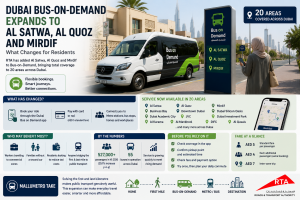
Dubai’s Roads and Transport Authority has expanded Bus-on-Demand to Al Satwa, Al Quoz and Mirdif, bringing the service to 20 areas across the city.
Unlike a traditional bus route, the service uses smaller buses that respond to bookings made through the Dubai Bus on Demand app rather than following one fixed route and timetable. Riders enter their pickup and destination, and the app provides the available vehicle, estimated arrival time and journey information.
Why these three areas matter
The expansion is particularly relevant because the three neighbourhoods have very different travel patterns.
Al Satwa has dense residential and commercial activity close to central Dubai. Al Quoz combines residential areas with major commercial and industrial zones. Mirdif is a large residential community where many journeys still depend heavily on cars.
For some residents, an on-demand minibus could make the difference between using public transport for most of a journey and taking a taxi or car for the whole trip.
What does it cost?
RTA currently lists a standard Bus-on-Demand fare of AED 5 per passenger.
Additional passengers travelling in the same booking are charged AED 4 each, while an inter-zone trip is listed at AED 7. Payment options include credit or debit cards and nol cards.
That can make the service particularly interesting for people comparing it with the cost of a taxi for a short first- or last-mile connection.
The service is growing quickly
Bus-on-Demand carried around 527,000 passengers during the first half of 2026, according to RTA — 25.1% more than during the same period in 2025.
June alone recorded 105,990 passengers, the highest monthly figure in the first half of the year. RTA has also expanded the fleet to 55 buses.
Those numbers suggest the service is becoming more than a small transport experiment.
Who may find it useful?
The service could be particularly useful for workers travelling into commercial areas, households trying to manage with one car, students and residents whose homes are inconveniently located from a regular bus stop or Metro station.
It may also become more attractive during Dubai’s hotter months, when what looks like a reasonable walking distance on a map can feel very different in practice.
But it will not necessarily replace a car or taxi for every journey.
Pickup locations, waiting times and available connections depend on the actual service area and current demand.
Check the app before changing your commute
Bus-on-Demand is not the same as having a fixed bus stop outside your building.
Before depending on it for work or another time-sensitive journey, enter your actual origin and destination in the app and check:
pickup point → expected arrival → journey time → fare → onward connection
Trying the complete journey once before relying on it every day is probably the safest approach.
MalluMetro Take
Public transport becomes much more useful when it solves the journey between your front door and the main transport network.
Adding Al Satwa, Al Quoz and Mirdif may look modest beside a new Metro line, but for residents who previously needed a taxi or car just to reach the next part of their journey, it could have a much more immediate effect.
The real test is not how many areas appear on the coverage map — it is whether residents can complete the whole journey more easily and affordably.