
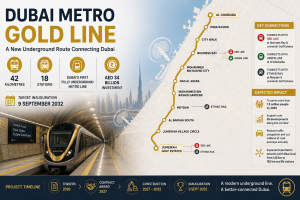
Dubai’s Metro map is set for another major change. The newly approved Gold Line will run entirely underground, connecting established parts of the city with some of Dubai’s fastest-growing communities.
The Dubai Metro Gold Line was approved in April 2026 with an investment of around AED 34 billion.
The planned route will extend for 42 kilometres across 18 stations, making it Dubai’s first fully underground Metro line. The official target for inauguration is 9 September 2032.
Where will the Gold Line go?
The route is planned to begin at Al Ghubaiba and travel through areas including Mina Rashid, City Walk, Business Bay, Mohammed Bin Rashid City, Nad Al Sheba, Mohammed bin Rashid Gardens, Meydan, Al Barsha South and Jumeirah Village Circle before reaching Jumeirah Golf Estates.
That makes the project more than simply another Metro extension.
It creates a new cross-city corridor linking older Dubai with major residential and development areas further south and east.
The Gold Line is also planned to connect with the Red Line at Business Bay and Jumeirah Golf Estates, the Green Line at Al Ghubaiba, and Etihad Rail at Meydan and Jumeirah Golf Estates.
For passengers, those interchange points may eventually matter as much as the new stations themselves because they could make journeys possible without relying on a car for the entire trip.
Why an underground line matters
Unlike much of Dubai’s existing elevated Metro infrastructure, the Gold Line will run entirely underground.
RTA says advanced tunnel-boring technology will be used, with the route reaching depths of around 40 metres in parts of the project.
For residents, that means the finished railway will have a much smaller visual presence at street level.
Construction is another matter.
Large underground rail projects still require station excavations, utility relocation, access areas and extensive logistics. Residents near future station locations should therefore expect the construction phase to look very different from the final railway.
How big could the impact be?
RTA projects that the Gold Line will serve more than 1.5 million people by 2040, with passenger numbers expected to reach around 465,000 per day beyond 2040. The project is also intended to support more than 55 developments along its corridor.
Once completed, the Gold Line is expected to take Dubai’s Metro network — including the Blue Line — from 120 km to 162 km and 85 stations.
RTA also expects the new route to reduce pressure on part of the existing Red Line and cut millions of road journeys annually.
Those forecasts are important, but they remain long-term projections rather than changes commuters will experience immediately.
What about property near the new stations?
This is where readers should be careful.
RTA itself says Metro accessibility can support property values and projects increases of up to 20% around stations as part of the Gold Line’s expected economic benefits.
But that should not be interpreted as a guarantee that every apartment or villa near the planned route will increase by 20%.
The eventual effect will depend on the exact station location, walking access, community development, supply of new property, service charges, market conditions and how long an investor is prepared to wait.
For someone considering buying or renting because of the Gold Line, the sensible approach is to wait for increasingly detailed official station information rather than buying purely because a development is advertised as being “near the future Metro.”
When will construction begin?
The official programme calls for tenders during 2026, contract award in 2027, followed by construction, with inauguration scheduled for 9 September 2032.
That timeline also helps put current property and commuting discussions into perspective: this is a major infrastructure project with several years of delivery ahead.
MalluMetro Take
The most interesting thing about the Gold Line is not simply that Dubai is adding another colour to the Metro map.
It is where the line connects.
Al Ghubaiba, Business Bay, Meydan, JVC and Jumeirah Golf Estates sit across very different parts of Dubai. Connecting them — while also linking the Red Line, Green Line and Etihad Rail — could eventually change how some residents think about cross-city travel.
But 2032 is still some distance away.
For commuters, tenants and property buyers, the useful approach is to follow confirmed station locations and construction milestones, rather than make expensive decisions based on early speculation.