
Not every project that changes daily life is a new Metro line, airport or skyscraper. Some of the most noticeable improvements happen at street level – in parks, markets, waterfronts and the public spaces people use every day.
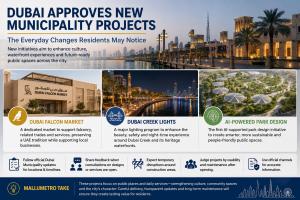
Dubai has approved a new group of Municipality projects covering very different parts of city life, including the Dubai Falcon Market, Dubai Creek Lights and an AI-supported park-design initiative.
Individually, they may not have the scale of Dubai’s biggest infrastructure projects. Together, however, they show how the city is continuing to invest in public spaces, traditional activities and new approaches to urban planning.
Dubai Falcon Market
The planned Falcon Market is intended to support a traditional activity with deep cultural importance in the UAE.
Rather than treating falconry simply as a heritage attraction, a dedicated market can bring together related trading, services and specialist activities in one location.
For residents, the direct impact may be limited compared with a road or transport project, but culturally focused projects can help traditional activities remain part of a rapidly modernising city.
Dubai Creek Lights
The Creek project may be much more visible to the wider public.
Dubai Municipality is developing a major lighting programme across the waterfront, promenades, walkways and heritage areas around Dubai Creek.
The aim is not simply to make buildings brighter.
Better lighting can improve pedestrian comfort, make waterfront areas more attractive in the evening and help highlight the architectural and historic character of one of Dubai’s oldest districts.
Can AI design a better park?
Perhaps the most unusual project is Dubai Municipality’s move to use artificial intelligence in park design.
AI could potentially help analyse factors such as space use, movement, landscaping and environmental conditions.
But residents are unlikely to care how sophisticated the software is if the finished park does not work well.
The questions that matter are much simpler:
Is there enough shade? Is it easy to walk through? Are there places for children and older residents? Is it accessible? Can it be maintained efficiently in Dubai’s climate?
Technology becomes valuable when it helps answer those questions better.
Why these smaller projects matter
A city’s quality of life is shaped by more than major infrastructure.
Lighting can determine whether people feel comfortable walking somewhere after dark. Parks influence where families spend their evenings. Markets can support local businesses and preserve cultural activities.
These changes may seem small individually, but residents experience them repeatedly.
That is why public-space projects should ultimately be judged by how well people use them after completion, not simply by how impressive they look in concept images.
What residents should watch
As the projects move forward, the most useful information will be the confirmed locations, construction timelines, access changes and opening dates.
For neighbourhood projects, residents should also watch for temporary diversions or changes around construction areas and use official Municipality channels for updates.
MalluMetro Take
Dubai’s biggest projects naturally attract the headlines, but everyday quality of life is often shaped by much smaller interventions.
A better-lit waterfront, a useful neighbourhood park or a well-planned public space may never have the visibility of a new Metro line.
But if people actually walk there, spend time there and keep coming back, the impact can be just as real.