
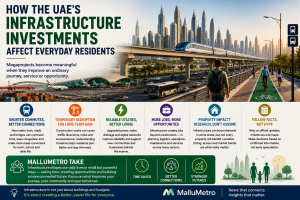
A new railway, road, airport terminal or power project may be announced in billions of dirhams. But for most residents, the number matters far less than a simpler question: will it make everyday life easier?
Infrastructure can affect where people live, how long they spend commuting, where businesses open and even which skills employers need.
The effects are not always immediate, and they are not always positive during construction. Understanding that difference can help residents make better decisions instead of reacting to every new project announcement.
A shorter commute can change more than travel time
Transport projects are often judged by how many kilometres of road or rail are being built.
For residents, the more useful measure is door-to-door journey time.
A new Metro station, interchange, bridge or bus connection can make previously inconvenient areas easier to reach. That can influence where people consider living, working or sending their children to school.
But a project does not improve a commute simply because it passes near a neighbourhood.
Walking access, feeder buses, parking, interchange time and the final kilometre of the journey all matter.
Construction can make things worse before they get better
Major infrastructure rarely appears without disruption.
Road diversions, utility works, temporary access changes, noise and additional construction traffic can affect residents and businesses for months or sometimes years.
That does not mean a project is failing.
It means residents should distinguish between the construction phase and the eventual benefit of the completed project.
Checking official traffic and project updates can be more useful than depending on neighbourhood rumours or old route maps.
Reliable utilities are infrastructure too
Some of the most important investments are almost invisible.
Electricity substations, water networks, drainage systems, telecommunications infrastructure and data capacity may never become tourist attractions, but they determine whether new communities and businesses can function reliably.
People usually notice these systems only when they stop working.
Good infrastructure often means not having to think about it at all.
Infrastructure also creates work beyond the construction site
A major project does not employ only engineers and construction workers.
Infrastructure programmes can create demand across planning, procurement, logistics, project management, safety, quality, ICT, finance, facilities management, operations and maintenance.
The employment effect can also continue after construction ends.
A new transport hub, logistics district or commercial area may support businesses and services that were not part of the original construction contract.
That is why professionals looking at infrastructure growth should think beyond the visible project itself.
Be careful with property claims
New transport links often generate excitement around nearby property.
There can be genuine advantages to living close to good infrastructure, but a project announcement does not guarantee that every nearby property will rise in value.
The exact station location, walking distance, project completion date, community supply, service charges and wider property market still matter.
A brochure saying “five minutes from the future Metro” should never replace proper research.
What should residents actually watch?
Instead of reacting to the headline value of a project, follow the things that directly affect daily life: confirmed routes and station locations, construction dates, temporary diversions, expected completion, public-transport connections and official opening milestones.
For property or major financial decisions, wait for confirmed information rather than relying on early promotional material.
MalluMetro Take
The UAE’s biggest infrastructure announcements often come with impressive numbers.
But residents experience infrastructure in much smaller ways:
Ten minutes saved on the morning commute, a bus connection closer to home, fewer traffic bottlenecks, more reliable electricity or a new business district creating work nearby.
That is the better way to judge infrastructure.
Not by how much it costs — but by what becomes easier once it is built.