
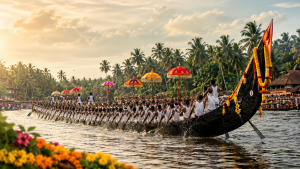
There are few images of Onam more instantly recognisable than a long snake boat cutting through Kerala’s backwaters, dozens of rowers moving together to the beat of song and rhythm.
Anizham, traditionally associated with Vallamkali, gives us a good point in the Onam journey to look at why Kerala’s boat-race culture has become such a powerful symbol of the festival.
A snake boat cannot move on individual effort
A chundan vallam is impressive because of its size and speed.
But what makes it extraordinary is coordination.
Dozens of rowers have to move almost as one. Rhythm matters. Timing matters. The person sitting beside you matters.
One rower pulling harder at the wrong moment does not necessarily make the boat faster.
The boat moves best when everyone moves together.
Perhaps that is why Vallamkali fits Onam so naturally.
The festival is also built around people coming together — families, neighbourhoods and communities preparing, eating and celebrating as a group.
A snake boat simply makes that idea spectacularly visible.
More than a race
For someone watching from the riverbank, Vallamkali can look like pure competition.
But the experience is much bigger than who crosses the line first.
There are the boats themselves, the songs, the crowds along the water, the preparation before the race and the months of practice needed for a crew to find its rhythm.
That combination of sport, tradition, landscape and community is what has made Kerala’s boat races one of the most enduring images associated with Onam.
Not every famous race happens on Anizham
This distinction is important.
Kerala’s major boat races follow their own local traditions and calendars. They should not all be presented as events happening specifically on Anizham.
For MalluMetro’s daily journey, Anizham is better understood as the day to explore the cultural connection between Onam and Vallamkali.
Individual races deserve their own dates and stories.
The Aranmula Vallamkali, for example, has a distinct tradition and place in the festival calendar and is better covered separately rather than folded into the Anizham story.
Why this image still connects with Malayalis abroad
A child growing up in Dubai or Abu Dhabi may never have stood beside a Kerala river during a boat race.
But the image is still easy to understand.
A long boat.
A large team.
One rhythm.
One destination.
For families abroad, that can become an easy way to explain something larger about Kerala culture: many traditions are built not around what one person can do, but around what people can accomplish together.
Watching an old race, listening to a Vallamkali song or simply explaining how the crews work can turn Anizham into something children can understand even thousands of kilometres away.
MalluMetro Take
A snake boat is powerful because no single rower can make it move properly alone.
Strength comes from rhythm, trust and everyone pulling together.
That may be why Vallamkali has become such a lasting image of Onam.
It is exciting to watch — but underneath the spectacle is a very simple idea:
When people move together, they can make something extraordinary happen.
For this article, I would again replace the long calendar note with your shorter standard footer: