
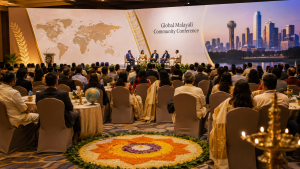
A global Malayali conference matters less for how many people attend than for what happens after everyone goes home.
The World Malayali Council has concluded its 15th global conference and 30th-anniversary celebrations in Dallas, following four days of meetings, discussions, cultural programmes and community activity from 21 to 24 August 2026.
Representatives from different regions participated, and the gathering also included the announcement and installation of the organisation’s new global office-bearers for 2026–28.
For MalluMetro readers, however, the useful question is not who stood on the stage.
It is what a global Malayali network can realistically do for people living across different countries.
Why diaspora networks still matter
Malayalis abroad often need support that does not fit neatly inside one official system.
A newcomer may need guidance.
A student may need contacts.
A family facing an emergency may need community support.
Children growing up abroad may need somewhere to learn Malayalam and experience Kerala’s culture.
Professionals and entrepreneurs may benefit from networks that connect people across countries and industries.
That is where organisations such as WMC can potentially add value — but only when networking turns into something practical.
The real test is what happens after the conference
Before the Dallas gathering, organisers had announced plans including Karunya Bhavanam, a housing initiative intended to construct homes for eligible families in Kerala. Another proposed initiative, led by WMC’s Philadelphia Province with Gandhi Bhavan, involved eco-friendly housing for tribal families.
Those are exactly the kinds of projects worth following.
But an announcement at a conference is only the beginning.
The useful questions now are:
- How much funding is actually secured?
- Who qualifies for the support?
- Who will select beneficiaries?
- What are the delivery dates?
- Which organisation is responsible for implementation?
- And eventually, how many families actually receive the promised benefit?
That is how community impact becomes measurable.
Culture still has a role
The Dallas conference also included cultural programmes, performances and recognition of people for contributions in business and community service.
Those activities should not be dismissed as purely ceremonial.
For a diaspora organisation, culture helps connect generations and creates a shared identity across countries.
But culture and networking become much stronger when they sit alongside education, welfare, mentoring and practical community projects.
Why this matters to Gulf Malayalis
The Gulf remains one of the most important centres of the global Malayali community, and Middle East representatives were among those involved in the Dallas conference preparations.
For Gulf residents, global organisations can potentially create useful bridges between Kerala, the Middle East, Europe, North America and other regions.
That might mean business connections.
It might mean educational opportunities.
Or it might simply mean having a trusted community network when someone moves to another country.
The value depends on what the organisation actually delivers.
MalluMetro Take
Global Malayali conferences can create visibility, relationships and cultural connection.
But attendance should not be treated as the final measure of success.
The stronger question is what survives after the banners come down:
Were homes built? Were students helped? Were professionals connected? Did families receive support? Did a useful programme continue?
That is where diaspora networking becomes more than networking.
And that is the part of the World Malayali Council’s Dallas conference worth following next.