
Onam has never needed a Kerala postcode to feel like Onam.
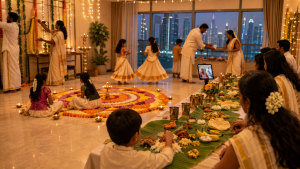
Across the Gulf and elsewhere in the world, community halls become temporary festival grounds. Children practise dances after school. Families arrive carrying payasam, traditional clothes and memories. Friends who have never celebrated Onam before are invited to sit down for a sadya and discover why one meal can mean so much.
For Malayalis living abroad, the festival inevitably changes.
But changing is not the same as disappearing.
When Onam travels, it adapts
In Kerala, celebrations follow the rhythm of the festival calendar, family gatherings and local traditions.
Abroad, life works differently.
Thiruvonam may fall on a working day. Children have school. Parents may struggle to get leave. Extended family could be thousands of kilometres away.
So the big celebration often moves to the nearest weekend.
A pookalam may be made inside an apartment instead of a courtyard. Traditional games may share the stage with school performances. Sadya might be served in a hotel ballroom or community hall rather than a family home.
None of that automatically makes the celebration less authentic.
It simply reflects a community finding a way to keep its traditions alive in a different place.
Friends can become part of the festival family
One of the interesting things about celebrating Onam abroad is that the guest list often becomes wider.
A colleague from another Indian state may join the sadya. A Filipino, Arab or European friend may ask why everyone is eating from a banana leaf. A child’s school friends may see a pookalam for the first time.
Those moments matter.
Explaining Onam to someone else often forces us to think about why we celebrate it ourselves.
And a festival becomes stronger when people are welcomed into it rather than simply asked to watch from the outside.
The next generation needs more than a stage programme
For children growing up abroad, Onam cannot survive only as something their parents remember.
They need experiences of their own.
Let them choose flowers for the pookalam.
Ask them to help serve the sadya.
Teach them the name of one dish.
Explain why people wear traditional clothes.
Call grandparents and ask them what Onam was like when they were young.
And let children invite their friends.
That is how a tradition moves from “something my parents celebrate” to “something that belongs to me too.”
You don’t have to recreate Kerala perfectly
Sometimes diaspora celebrations become so focused on recreating an ideal version of Onam that the festival itself becomes stressful.
It does not have to be perfect.
The pookalam can be small.
Some dishes can be ordered.
The community programme can happen a week later.
A family member can join through a video call.
The important question is not whether the celebration looks exactly like Onam in Kerala.
It is whether people still understand what they are celebrating and why they want to gather together.
MalluMetro Take
Diaspora culture is strongest when it becomes more than a stage programme or an annual photograph.
The Onam memories that last may be surprisingly ordinary:
making a flower carpet together, learning the name of a dish, calling grandparents, laughing through a badly rehearsed dance or explaining the festival to a friend for the first time.
Kerala may be where Onam began.
But wherever Malayalis have built a life, Onam has found a way to come with them.