
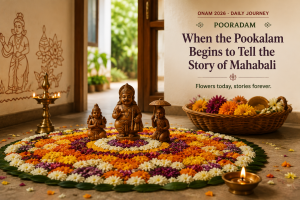
Onam’s best-known story is about Mahabali returning to visit the people who still remember him with affection. Kerala Tourism describes Mahabali as the generous ruler whose annual return is celebrated through Onam.
By Pooradam, that story can begin appearing more visibly alongside the flowers.
In some parts of Kerala, families traditionally begin placing small clay forms within or near the pookalam during this stage of the festival. The names, forms and exact day they appear can vary from region to region. Kerala Tourism records traditions involving Mathevar, Maveli and Thrikkakara Appan, among others.
That variation is worth preserving rather than trying to turn every family’s Onam into one standard ritual.
The story matters more than the ornament
For a child, the first question may simply be:
“Who is that beside the flowers?”
That question is an opportunity.
Parents can explain the story of Mahabali — remembered in the Onam tradition as a generous ruler whose reign represented prosperity and equality, and who is believed to return to visit his people during the festival.
The story is also closely connected with Vamana, the form of Vishnu whose encounter with Mahabali forms the central legend associated with Onam. Thrikkakara’s Vamanamoorthy Temple remains especially important to this tradition and honours both Vamana and Mahabali.
Families may understand the story religiously, culturally or through a mixture of both.
MalluMetro does not need to decide which interpretation is the “correct” one.
The more useful role is to explain why these familiar figures and symbols appear during Onam.
By Pooradam, the pookalam has its own history
Think back to Atham.
The pookalam began simply.
Then Chithira added another layer. More colours arrived. The design expanded. Every morning contributed something new.
Kerala Tourism’s account of the tradition describes the floral carpet growing progressively throughout the ten-day Onam period, with regional customs changing its shape, flowers and accompanying elements along the way.
By Pooradam, the pookalam is no longer simply something pretty on the floor.
It has become a record of the family’s journey towards Thiruvonam.
Let children add something of their own
Pooradam can be a good day to let children choose part of the design themselves.
Give them a few flowers.
Let them decide where one colour should go.
And while they are sitting beside the pookalam, tell them who Mahabali is and why Kerala prepares to welcome him every year.
For children growing up in the Gulf, that conversation may matter more than creating a technically perfect floral design.
A tradition survives when the next generation understands the story behind what they are being asked to do.
MalluMetro Take
Pooradam reminds us that a pookalam can be more than decoration.
By now, it carries several days of preparation, family participation and anticipation.
And when the story of Mahabali enters the conversation, the flowers begin to carry meaning too.
Let children help build the pookalam — but also tell them who Kerala is preparing to welcome.
That story may stay with them long after the flowers are gone.