
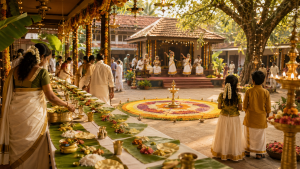
By Moolam, Onam is no longer something happening only inside individual homes.
The pookalam has been growing for days, preparations for Thiruvonam are well underway, and food, music and cultural performances begin bringing larger groups of people together.
Kerala Tourism describes Moolam, the seventh day of Onam, as the stage when Onasadya offerings begin, alongside traditional performances such as Pulikali and Kaikottukali.
For Malayalis living outside Kerala, that makes Moolam a good day to think about another important part of Onam:
community.
A sadya feels different when the table gets bigger
There is something special about a family Onasadya.
But a community sadya has a different kind of energy.
Schools, associations, workplaces, temples and neighbourhood groups may bring together people who would otherwise celebrate separately.
In the Gulf, that can matter even more.
Parents may be in Kerala. Brothers and sisters may live in different countries. Annual leave may not fall anywhere near Thiruvonam.
So friends, colleagues and community groups often become part of the festival family.
The banana leaf stays the same.
The circle around it simply becomes bigger.
Culture becomes something you can see
Onam is also one of those festivals that becomes easier to understand when it is performed.
Music, dance, games, traditional clothes, pookalam and food turn ideas about Kerala culture into something children can actually experience.
A child growing up in Dubai or Abu Dhabi might first encounter Kaikottikali on a school stage.
They may see Pulikali in a video before ever watching it on the streets of Thrissur.
That is not necessarily a weaker connection.
It can be the beginning of one.
The important part comes afterwards — when someone explains what they have just seen and why people continue doing it.
Community celebrations can create new traditions too
For Gulf Malayalis, an Onam programme in a school auditorium or community hall may look very different from celebrations in Kerala.
But children growing up abroad may eventually remember those occasions just as strongly.
The friend who sat beside them during sadya.
The first time they wore a mundu or kasavu dress.
The dance their parents practised for weeks.
The Malayalam song everyone somehow knew the chorus to.
Traditions do not survive only by being preserved exactly.
Sometimes they survive because communities find new places to practise them together.
MalluMetro Take
Moolam reminds us that Onam becomes bigger when it is shared.
A family can keep a tradition alive.
A community can help it travel across generations and across borders.
For Malayalis living far from Kerala, that may be one of the most valuable parts of community Onam celebrations:
they give children somewhere to see, hear, taste and experience a culture that might otherwise exist mainly in stories from home.
And once those children begin asking “Why do we do this?”, the tradition has another chance to continue.