
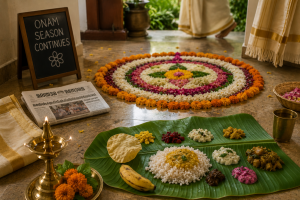
Thiruvonam is the heart of Onam.
But it is not the moment when the festival suddenly stops.
After the flowers, feast and excitement of the main day comes Avittam, associated in Kerala’s 2026 calendar with Third Onam on 27 August.
The mood is different now.
The biggest preparations may be behind us, but visits continue, community programmes carry on and some of Kerala’s local festival traditions are only beginning.
The day after the big celebration feels different
Every major festival needs a day when the pace changes.
The kitchen may still be full of food.
Relatives are still around.
Children are still in festival mode.
And somewhere in the house there is probably evidence that everyone was too tired to clean properly the night before.
Avittam carries that quieter feeling.
Onam is no longer approaching.
It has happened – and people are still enjoying being together.
But Kerala’s Onam traditions are still moving
Avittam is not simply a recovery day everywhere.
In Neelamperoor in Alappuzha district, for example, the famous Neelamperoor Padayani begins on Avittam and continues for 16 days. Kerala Tourism describes it as a distinctive ritual tradition performed during the Malayalam month of Chingam.
At Payippad, the well-known three-day boat-race tradition also continues beyond Thiruvonam. Kerala Tourism says Avittam is the day of the colourful water procession, followed by the final race on Chathayam.
That is a useful reminder:
Onam is not one identical celebration happening everywhere in Kerala.
Different places carry the season forward in different ways.
What happens to the pookalam?
Families also differ in how long they keep or change the pookalam and other festival arrangements.
There is no need for MalluMetro to present one household custom as the universal rule.
The more interesting idea is that the floral journey that began on Atham has now reached the other side of Thiruvonam.
For children, that can be part of the lesson too.
Festivals have a beginning, a peak – and then a gentle ending.
Why Avittam may feel especially familiar in the Gulf
For Malayalis abroad, the timetable can be almost reversed.
Thiruvonam may fall on a normal working day, while the big community celebration happens after it, on Friday, Saturday or another convenient weekend.
So while Kerala’s formal calendar is moving beyond its central day, an association in Dubai, Abu Dhabi, Doha or elsewhere may still be preparing for its largest Onam gathering.
That does not make it late.
It is simply how a festival adapts when it travels.
A community hall full of families several days after Thiruvonam can carry just as much meaning as a celebration on the official date.
Culture does not switch off at midnight
Perhaps that is Avittam’s most useful message for a global Malayali generation.
A festival is not finished because one date has passed.
People may still be visiting.
Children may still be performing.
Community sadya may still be ahead.
And some traditions in Kerala are only beginning their next chapter.
MalluMetro Take
Thiruvonam may be the centre of Onam, but Avittam reminds us that celebration has an afterglow.
The biggest meal may be over.
The pookalam may begin changing.
But the visits, stories, performances and sense of togetherness can continue.
For Malayalis abroad, that idea feels especially natural.
Onam does not disappear when the calendar moves to the next day. It lasts as long as people are still finding reasons to come together.