
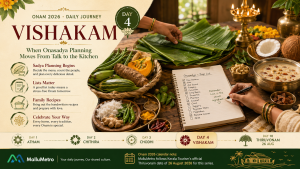
There comes a point in every Onam season when the conversation inevitably turns to food.
Vishakam is that point.
Kerala Tourism describes Vishakam, the fourth day of the ten-day Onam celebration, as the beginning of preparations for the grand Onasadya.
That does not mean the entire feast has to be cooked today.
It means the questions begin.
Do we have banana leaves? Who is making avial? Which payasam? Are we making everything at home? And the question capable of starting a friendly argument in almost any Malayali family:
How many dishes are actually enough?
Sadya is organisation disguised as abundance
When an Onasadya finally arrives on the banana leaf, it can look wonderfully effortless.
It isn’t.
A traditional sadya brings together many different preparations, from pickles and thoran to avial, olan, sambar, pappadam and payasam.
Some dishes can be prepared early. Others are better made closer to serving time. Vegetables need chopping, coconuts need grating, ingredients need organising and somehow everything has to reach the leaf at roughly the right moment.
Behind the abundance is usually planning — and a lot of shared work.
And perhaps that is part of what makes the meal special.
A Gulf sadya may look a little different
For Malayalis living in the Gulf, the practical side of Onasadya naturally changes.
Banana leaves may need to be ordered. A particular Kerala vegetable may be difficult to find or surprisingly expensive. Work schedules may mean the family celebrates on Friday, Saturday or Sunday rather than on the exact festival day.
Some families will cook everything.
Others will make a few favourite dishes at home and order the rest.
Neither choice makes an Onam celebration less meaningful.
A sadya should bring people together — not leave one person exhausted in the kitchen while everyone else celebrates.
Recipes can become family archives
Vishakam is also a good time to make a phone call.
Not necessarily to ask what to buy.
Call the person whose recipe everyone in the family still follows.
Maybe it is your mother’s olan.
Your aunt’s injipuli.
A grandmother’s payasam.
Or the relative who insists there is only one correct order in which dishes should appear on the banana leaf.
Those little instructions can carry surprising amounts of family history.
If there is one dish your family makes every Onam, write the recipe down this year.
Ask about the measurements, but ask about the story too.
Who taught them?
Was it always made this way?
Did they use the same ingredients when they were children?
A recipe preserved today may become something a child living in Dubai, Abu Dhabi or Doha cooks decades from now.
Don’t plan the biggest sadya. Plan yours.
Social media can make festival meals look like competitions.
They don’t need to be.
Five dishes prepared happily and eaten together can create a better Onam memory than twenty-five dishes prepared under stress.
Choose the foods your family actually enjoys.
Give children a small job.
Let someone make the payasam for the first time.
And if something goes wrong, that may eventually become the story everyone remembers.
MalluMetro Take
Vishakam reminds us that Onasadya begins long before anyone sits in front of a banana leaf.
It begins with a list, a recipe, a trip to the market and people deciding who will do what.
But perhaps the most valuable preparation this year is simpler:
Ask for one family recipe. Write it down. Pass it on.
Because sometimes culture survives not in books or museums, but in knowing exactly how much jaggery grandmother meant when she said, “just enough.”