
For nine days, something has been added.
A flower.
A recipe.
A new set of clothes.
A journey home.
A story told to a child.
A meal planned with family.
And then Thiruvonam arrives.
Kerala Tourism lists 26 August 2026 as Thiruvonam – the tenth and most important day of the traditional Onam celebration.
This is the day towards which the entire journey from Atham has been moving.
Why Mahabali remains at the heart of Onam
The best-known story of Onam is the annual return of King Mahabali.
In Kerala’s tradition, Mahabali is remembered as a generous ruler associated with an age of prosperity, happiness and equality. The legend tells how Vishnu appeared as Vamana and asked Mahabali for three steps of land.
After Vamana revealed his divine form, Mahabali eventually offered himself for the final step. His humility was rewarded with permission to return and visit his people once every year – the homecoming celebrated through Onam.
Families may understand that story through religious, cultural or personal traditions.
But some of the ideas that have travelled with it are remarkably universal:
welcome people generously, share what you have and remember a world in which prosperity should reach everyone.
Why Onasadya is more than a large meal
Then comes the part of Thiruvonam almost everyone looks forward to:
Onasadya.
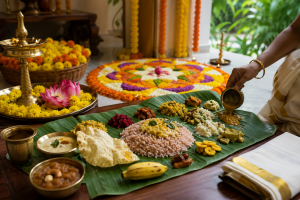
The banana leaf can carry an extraordinary variety of flavours – vegetables, curries, pickles, pappadam and payasam – but the meaning of the meal is not simply how many dishes appear.
It is that people sit down and share it together.
Recipes change from family to family. The serving order can inspire passionate debate. One household’s essential dish may be completely different from another’s.
That variety is part of the tradition rather than a problem with it.
The sadya does not need to be enormous to be meaningful.
Sometimes the most important ingredient is simply who is sitting beside you.
The pookalam has completed its journey too
Think back to Atham.
The first pookalam began simply.
Each day brought another layer, colour or idea.
By Thiruvonam, what began as a few flowers has become something much larger – just as the festival itself has moved from preparation towards celebration.
That gradual journey is easy to overlook when we see only the finished photograph.
But perhaps the ten days are important precisely because Onam was never meant to arrive all at once.
What does Thiruvonam look like in the Gulf?
For Malayalis abroad, the day may look very different.
Someone may make a small pookalam before leaving for work.
Children may celebrate at school.
A full sadya may wait until the weekend.
Grandparents in Kerala might join through a phone screen propped up at the end of the table.
None of that makes it a lesser Onam.
A pookalam in a Dubai apartment and one in a Kerala courtyard may look different, but they can carry the same memory, story and sense of belonging.
For a global Malayali generation, perhaps that is how traditions survive: not by staying exactly the same, but by remaining meaningful wherever families go.
MalluMetro Take
Thiruvonam is the heart of Onam because everything finally comes together.
The flowers.
The food.
The clothes.
The stories.
The people we travelled to see – and the people we wish could have been there.
After nine days of preparation, today is not really about adding anything more.
It is about enjoying what has already been brought together.
So sit down.
Share the sadya.
Call someone who is far away.
Tell the children the story once more.
And wherever you are celebrating:
Happy Onam.